

How to Choose Your First Camera: The Ultimate Beginner’s Guide for Malaysians
Stepping into the world of photography and videography is incredibly exciting, but walking into a camera shop in Plaza Low Yat or browsing through Shopee and Lazada can quickly feel overwhelming. Specs like “APS-C sensors,” “IBIS,” and “bitrates” sound like a foreign language.
If you are trying to figure out how to choose your first camera, you have likely asked yourself: Should I get a DSLR or mirrorless? Is full-frame worth the money? What fits my budget in Ringgit (MYR)?
This comprehensive guide breaks down everything you need to know to find the perfect starter camera in Malaysia, ensuring you don’t waste money on overhyped gear you don’t need.
1. Mirrorless vs. DSLR: Which System is Right for You?
For over a decade, the Digital Single-Lens Reflex (DSLR) was the gold standard. However, the industry has fundamentally shifted. When buying a camera, your first decision is choosing between these two systems.
What is a DSLR?
DSLRs use a mechanical mirror to reflect light from the lens up into an optical viewfinder. When you press the shutter, the mirror flips up, and the sensor exposes the image.
Pros: Incredible battery life (easily 1,000+ shots per charge), robust body ergonomics, and a massive secondary market for cheap, used lenses (especially Canon EF and Nikon F mounts).
Cons: Bulkier and heavier, slower autofocus in video mode, and what you see in the viewfinder isn’t exactly what the final photo will look like.
What is a Mirrorless Camera?
Mirrorless cameras remove the internal mirror completely. Light passes through the lens straight onto the digital sensor, which sends a live preview directly to an Electronic Viewfinder (EVF) or the rear LCD screen.
Pros: Lighter and more compact, real-time exposure preview (what you see is what you get), superior eye-tracking autofocus, and advanced video capabilities.
Cons: Shorter battery life (requires carrying spare batteries), and higher initial entry price for native lenses.
The Verdict: If you are buying new, go mirrorless. Camera manufacturers have stopped developing new DSLR bodies and lenses. A mirrorless system gives you the most future-proof ecosystem. However, if you are on a tight budget under RM2,000, a secondhand DSLR remains an excellent tool for learning manual exposure.
2. Deciphering Sensor Sizes (Without the Complicated Math)
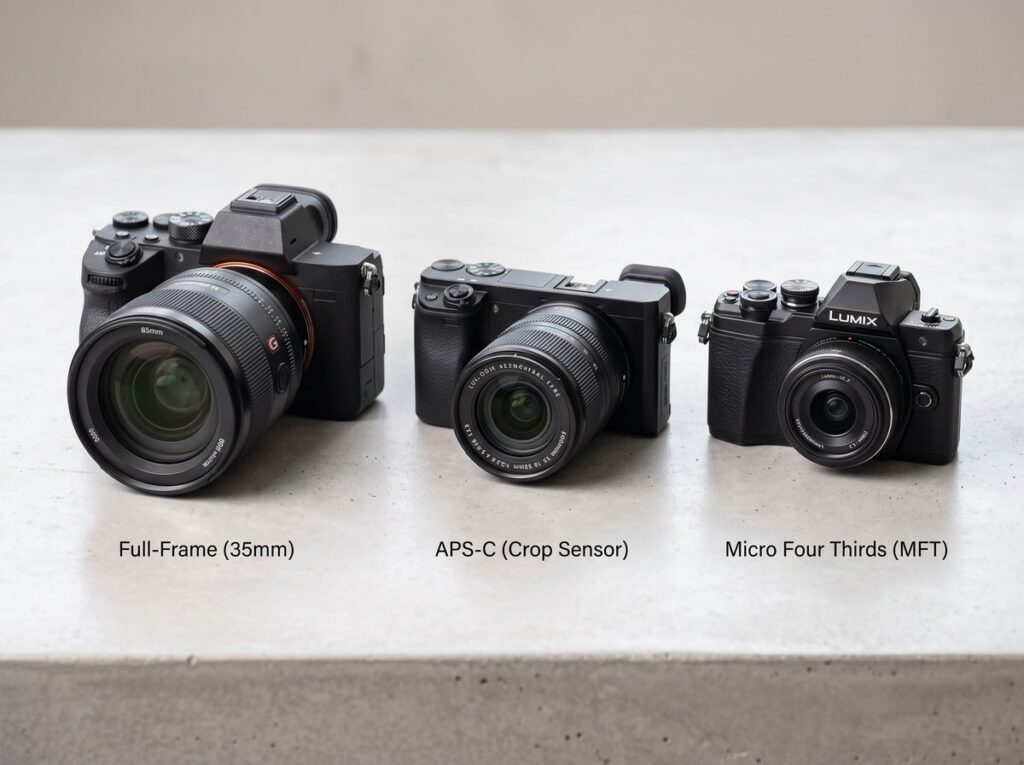
The sensor is the digital “film” of your camera. It captures light and determines image quality, low-light performance, and background blur (bokeh). For beginners, three main sensor sizes matter:
+-------------------------------------------------------+
| Full-Frame (35mm)                                    |
| Best low-light & dynamic range. Expensive.            |
|                                                       |
|   +-----------------------------------------------+   |
|   | APS-C (Crop Sensor)                           |   |
|   | The sweet spot for price & performance.       |   |
|   |                                               |   |
|   |   +---------------------------------------+   |   |
|   |   | Micro Four Thirds (MFT)               |   |   |
|   |   | Ultra-compact lenses. Great for travel|   |   |
|   +---+---------------------------------------+---+   |
+-------------------------------------------------------+
Full-Frame
This matches the size of traditional 35mm film. It offers the best dynamic range, exceptional performance in low-light environments (like capturing the vibrant colors of Kuala Lumpur’s night markets), and shallow depth of field.
The Catch: Bodies and lenses are significantly heavier and far more expensive, usually starting above RM6,000.
APS-C (Crop Sensor)
Slightly smaller than full-frame, this is the ideal sweet spot for most beginners. It balances high image quality with highly portable bodies and affordable lenses. Popular options like the Canon EOS R50 or Sony a6400 use this format.
Micro Four Thirds (MFT)
Mainly used by Panasonic and OM System (Olympus), these sensors are roughly half the size of full-frame. Because the sensor is small, the lenses are incredibly compact. It is perfect for lightweight travel photography or wildlife shooters who need long focal lengths without carrying heavy glass.
3. Demystifying Essential Camera Specs
When comparing camera models online, cut through the marketing fluff and focus on these five critical specifications:
a. Autofocus (AF) Tracking
Modern mirrorless cameras feature AI-driven Real-time Eye AF (Human and Animal). If you plan to shoot portraits, weddings, fast-moving events, or active children, a camera with reliable subject tracking saves you hours of frustration and out-of-focus shots.
b. In-Body Image Stabilization (IBIS)
IBIS physically moves the sensor inside the camera body to compensate for shaky hands. This feature allows you to shoot at slower shutter speeds in low light without getting blurry images, and it keeps handheld video footage steady. If a body lacks IBIS, look for lenses that feature optical stabilization (indicated by terms like IS, OSS, or VR).
c. Video Resolution and Frame Rates
Do not look just at “4K.” Look at how that 4K is recorded:
- 4K at 24p/30p: Standard cinematic and casual video frame rates.
- 4K at 60p: Allows you to slow down your 4K footage into smooth slow-motion.
- Log Profiles (S-Log, D-Log, V-Log): Advanced color profiles for video editors who want to color grade their footage later.
d. Ergonomics and Screen Articulation
A camera must feel comfortable in your hands. Additionally, choose the right screen mechanism for your shooting style:
- Tilt Screens: Move up and down. Excellent for low-angle landscape photography.
- Vari-angle (Flip-out) Screens: Articulate completely to the side and face forward. Essential if you plan to create content, vlog, or shoot vertical video for TikTok and Instagram Reels.
4. Setting a Realistic Budget in Malaysia
A very common mistake beginners make is spending 100% of their budget on the camera body, leaving no money for a proper lens, fast memory cards, or extra batteries.
When planning your purchase, divide your budget into three distinct tiers:
| Budget Tier | Expected Investment | Ideal Target Audience | Recommended Setup Examples |
|---|---|---|---|
| The Entry Tier | RM2,000 – RM3,500 | Casual hobbyists, family photographers, and content creators on a budget. | Canon EOS R100, Sony ZV-E10 (Mark I), used Fujifilm X-T200. Includes a standard 15-45mm or 16-50mm kit lens. |
| The Sweet Spot | RM3,500 – RM6,000 | Serious enthusiasts, hybrid creators (photo + video), and travel bloggers. | Canon EOS R50 / R10, Sony a6400 / ZV-E10 II, Fujifilm X-T30 II. Leaves room for an affordable prime lens. |
| The Prosumer Tier | RM6,500+ | Aspiring professionals, commercial videographers, and low-light shooters. | Sony a7 III / a7 IV, Fujifilm X-T5, Panasonic Lumix S5II. Entry into full-frame ecosystems. |
5. The Kit Lens Dilemma: Why You Need a “Prime” Lens
Most beginner cameras come bundled with a “kit lens”—typically an 18-55mm or 15-45mm zoom lens. While versatile, kit lenses have a variable aperture (usually f/3.5 – f/5.6). This design means that as you zoom in, the lens lets in less light, making it difficult to achieve a blurry background or shoot clean images at night.
To truly unlock your camera’s potential, budget around RM600 to RM1,500 for a 50mm f/1.8 or 35mm f/1.8 prime lens (a lens with a fixed focal length that cannot zoom).
Why a Prime Lens Changes Everything?
- Large Aperture (f/1.8): Lets in significantly more light than a kit lens, allowing for much cleaner night shots.
- Shallow Depth of Field: Creates a beautiful, blurry background that separates your subject from the environment, giving your portraits a professional look.
- Sharper Optics: Fewer moving glass elements inside the lens mean crisper images compared to budget zooms.
6. How to Choose a Camera Based on Your Creative Goals
Different creative paths require different tools. Match your primary shooting style to the right set of features:
The Travel & Landscape Photographer
If you love hiking in Mossy Forest or shooting seascapes in Langkawi, prioritize weight, battery life, and weather sealing.
Key Features: Compact body, tilting screen, high megapixel count (24MP+), and good dynamic range.
Top Picks: Fujifilm X-E4/X-T30 II, Nikon Z fc, Olympus OM-D E-M10 Mark IV.
The Content Creator & Vlogger
If your primary goal is creating high-quality videos for YouTube, TikTok, or Instagram, autofocus and audio infrastructure are your top priorities.
Key Features: Fully articulating flip-screen, uncropped 4K video, reliable microphone input (3.5mm jack), and class-leading subject tracking.
Top Picks: Sony ZV-E10 II, Canon EOS R50, Panasonic Lumix G100.
The Everyday Hobbyist & Street Photographer
If you want a camera to document daily life, cafe-hopping in Penang, or urban street scenes in Bukit Bintang, you need discretion and speed.
Key Features: Minimalist design, fast startup time, physical control dials, and an inconspicuous profile.
Top Picks: Ricoh GR III / GR IIIx, Fujifilm X-M5, Sony a6400.
7. Where to Buy Camera Gear Safely in Malaysia
Purchasing camera equipment is a significant investment. Protect your money by choosing reliable retail channels:
Official Authorized Dealers
For brand-new gear with official local warranties (e.g., Sony Malaysia, Canon Marketing Malaysia), purchase from established specialty camera retailers. Notable stores include:
- Shashinki (Massive online inventory)
- YL Camera (Pudu/PJ physical stores, great for new and trade-ins)
- J-Dan Camera (Popular among KL-based creators)
- Altech Camera (Excellent reputation for both new and inspected used gear)
Online Marketplaces (Shopee & Lazada)
If buying online, ensure the store lists the item as “Original Malaysia Warranty” rather than an import or “grey market” set. Grey market sets are often cheaper but will not be repaired by official service centers in Malaysia if something goes wrong.
Online Marketplaces (Shopee & Lazada)
If buying online, ensure the store lists the item as “Original Malaysia Warranty” rather than an import or “grey market” set. Grey market sets are often cheaper but will not be repaired by official service centers in Malaysia if something goes wrong.
Conclusion: Stop Researching and Start Shooting
There is no single “perfect” camera—only the camera that fits your current budget and goals. Do not let analysis paralysis keep you from starting your creative journey. Pick a modern mirrorless system that feels comfortable to hold, budget for a versatile lens, and spend the rest of your time practicing the fundamentals of light and composition.