

Hollywood's VFX Secret Rules and the Bayer Pattern's Digital Code
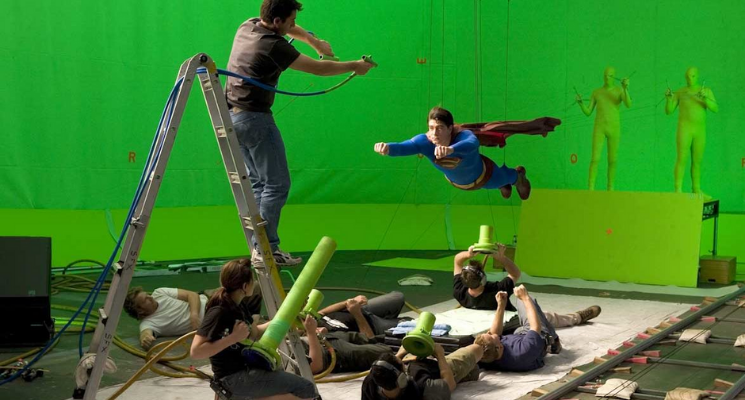
Dispel the myth that “VFX only uses green screens.” We provide a deep dive into why, for night scenes or when actors have blonde hair/green clothing, crews must return to the traditional “Blue Screen.” Simultaneously, we unearth the Bayer Pattern principle underlying digital camera sensors to explain why green pixels dominate and provide the cleanest edge details. Finally, we break down how crews in the field balance “reflectance and lighting budgets” when choosing screen colors.
Dispelling the Myth: It's Not All About the Green
Whenever movie special effects are mentioned, most people immediately think of walls covered in a cheap, vibrant green. In countless behind-the-scenes features, “Green Screen” is practically synonymous with VFX (Visual Effects). But this is a classic case of survivorship bias.
In Hollywood, the choice of screen color is never arbitrary. It’s based on rigorous scientific logic and established industry “secret rules.” Traditional blue screens haven’t exited the historical stage; they remain the indispensable kings of specific filming scenarios.
The Revenge of the Blue Screen: Night Scenes and Special Attire
Since we have green screens, why use blue screens? It depends entirely on what is being filmed. Rule one for screen choice: it must be a color completely absent from the actors and props.
- Attire Restrictions: If an actor is playing a green character (like The Hulk) or wears clothing with green stripes or green jewelry, a green screen is absolutely out of the question, or parts of the actor will be keyed out.
- Blonde Hair and Spill: Spill is the keyer’s worst nightmare. The background screen color reflects onto the actor’s skin and hair edges. For blonde actors, green spill makes their hair look like terrible grass-green, which is very hard to clean. Blue spill, conversely, merely desaturates blonde hair, making it look slightly grey—much easier to fix in post.
- Low Light and Night Scenes: Blue has a shorter wavelength and, therefore, lower luminosity reflectance than green. For night, rain, or mood-lit scenes, using a blue screen significantly reduces “light pollution,” allowing the cinematographer to maintain the intended lighting quality on the actors for a more realistic final composite.

The Digital Secret: Why Cameras Love Green?
Given its advantages, why has the green screen dominated the modern digital era? The answer lies in the fundamental structure of digital camera sensors: The Bayer Pattern.
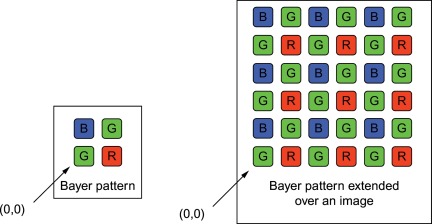
On a digital camera’s CMOS sensor, every individual pixel cannot detect all colors simultaneously. A scientist named Bryce Bayer invented an array to place a different colored filter over each pixel.
If you look closely at this array, you’ll discover a shocking secret: within a minimum 2×2 pixel unit, there is one red filter, one blue filter, but TWO green filters (a ratio of 1R:1B:2G).
Why did scientists do this? Because the human eye is most sensitive to green light. To mimic human visual characteristics, digital cameras are built to sample the “Green Channel” at twice the rate of the red and blue channels.
In digital imagery, the Green Channel contains the most luminance and detail information. For keying requiring precise edges, the green channel has the lowest noise and the cleanest computational power. This fundamental “computational favoritism” from the digital core is the primary reason why green screens reign supreme in the digital era.
Tactical Gambits: Reflectance and Lighting Budget
Of course, beyond the science, crews must also consider realistic cost and lighting factors.
- Luminosity Difference: Green is far more reflective than blue. This means lighting a large green screen requires fewer lights and consumes less power—saving money. For smaller productions or setups needing to light vast screen areas (like massive indoor sets for Avengers), green is the more economical choice.
- The Spill Cost: However, higher reflectance also means more severe spill. Film crews must spend more time and effort precisely controlling the lights to prevent green light from bouncing onto the actors. It’s a delicate tactical balance.
Reflections
Green and Blue: appearing as merely two screen colors, they represent the Hollywood VFX industry’s balancing act between artistic pursuit and underlying physics. The rise of green screen wasn’t accidental; it was the hardware manifestation of the digital sensor’s computational favoritism for green algorithms. The endurance of the blue screen proves that in the face of lighting texture, night scenes, and specific attire details, even the strongest algorithms must bow to the rules of physics. This confirms our column’s core view: In film and TV, technology always serves art, and the ultimate technical innovation always stems from the most precise mimicry of human perception.