

From Explosive Powder to High-Speed Sync (HSS)

Before artificial light sources existed, photographers were completely at the mercy of the sun. Once darkness fell or shooting moved indoors, cameras became useless. To capture images in dark environments, 19th-century pioneers did something extraordinary: they detonated chemical explosives. From dangerous magnesium explosions that burned studio curtains to vacuum flashbulbs, electronic speedlights, and modern High-Speed Sync (HSS) capable of darkening the midday sun, the evolution of flash photography is an epic story of engineering violence and control over light.
1. The Violent Birth of Artificial Light: Magnesium Powder to Flashbulbs
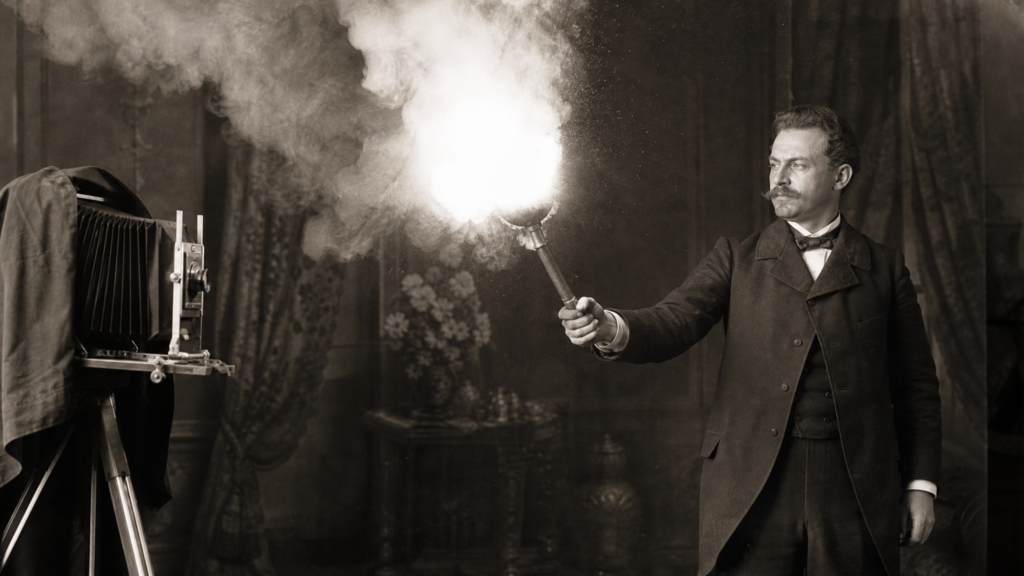
In the mid-19th century, wet plate and dry plate collodion emulsions had extremely low sensitivity. Indoor portraits required subjects to sit motionless for seconds or even minutes. To generate intense instantaneous illumination, scientists turned to chemistry.
In the 1860s, German chemists discovered that burning magnesium wire emitted blinding white light. However, magnesium wire burned too slowly for shutter-speed exposures. Photographers made a radical leap: mixing powdered magnesium with strong oxidizing agents like potassium chlorate to create volatile “flash powder.”
- Explosive Illumination: Photographers or assistants poured flash powder onto an open flash pan and ignited it. With a deafening boom, a blinding flash, sulfur fumes, and thick white smoke, an exposure was made.
- Occupational Hazards: Flash powder was notoriously unpredictable. Misjudged chemical ratios led to severe studio fires, singed eyebrows, and maimed hands. White residue hung in studio air for hours after every shot.
It wasn’t until the late 1920s that German engineers developed the vacuum flashbulb, sealing fine aluminum or magnesium filaments inside oxygen-filled glass bulbs. While single-use and explosive internally, it contained the hazard safely inside glass. By the 1950s, high-voltage xenon gas electronic speedlights emerged, introducing reusable microsecond flashes.
2. The Physics Curse of Focal Plane Shutters: X-Sync Speed Limits
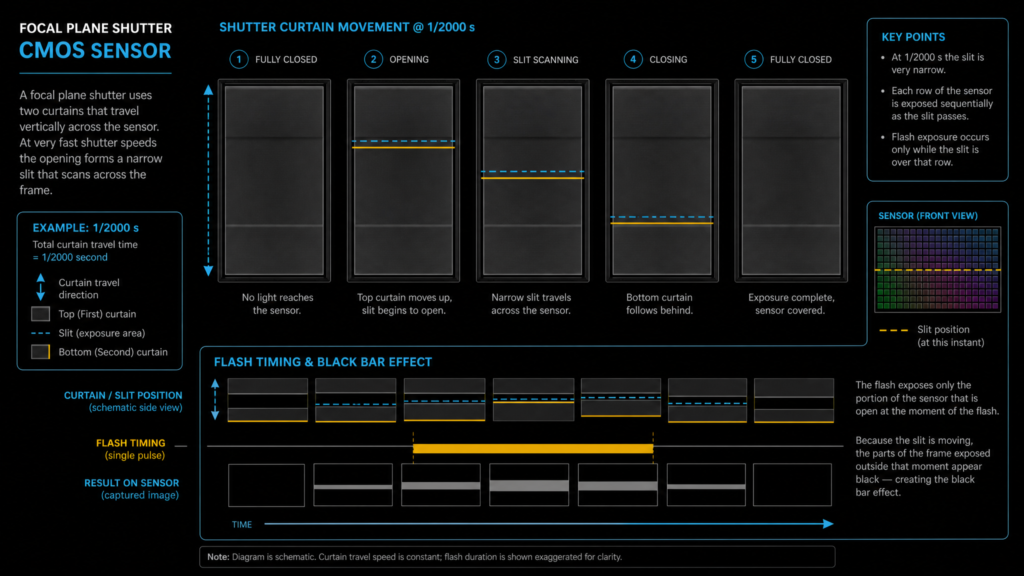
With electronic speedlights came a new physical barrier: Why does a dark black bar appear across the image when shutter speeds exceed 1/200s or 1/250s?
| Shutter Speed | Curtain Operation | Flash Result |
|---|---|---|
| At or Below Sync (≤ 1/250s) | The Front Curtain opens completely, exposing 100% of the CMOS sensor before the Rear Curtain begins closing. | The flash fires a single burst while the sensor is fully open, illuminating the entire frame evenly. |
| Above Sync (> 1/250s, e.g. 1/1000s) | The Rear Curtain chases the Front Curtain immediately, creating a narrow moving slit across the sensor. | The instantaneous flash burst only illuminates the slit portion; the rest remains blocked by curtains, creating a black bar. |
3. The Magic of High-Speed Sync (HSS): The Flash as a Machine Gun
Under bright midday sun, the 1/250s limit forces an impossible compromise: stopping down to f/11 destroys background blur, while opening to f/1.4 severely overexposes the ambient scene.
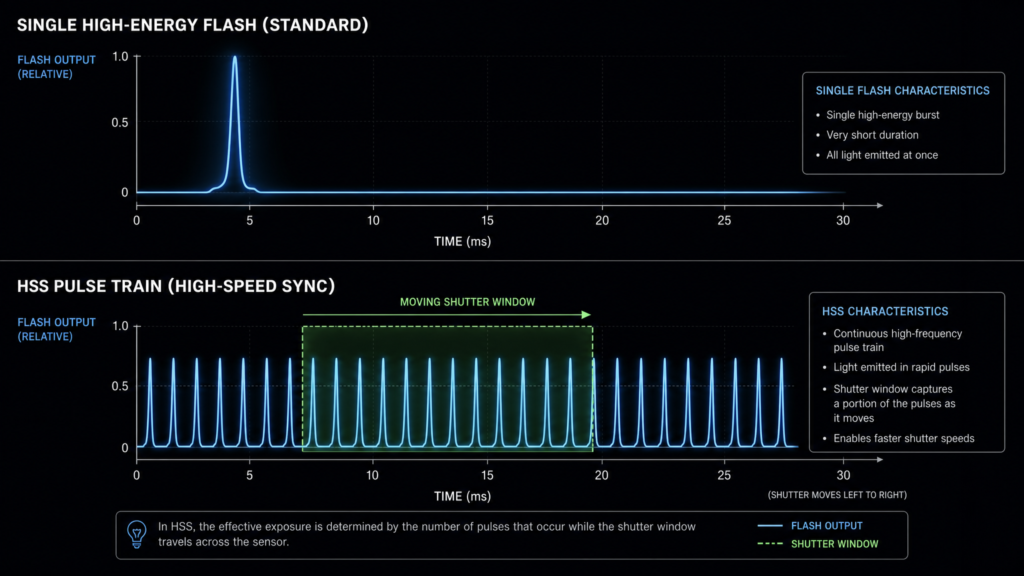
High-Speed Sync (HSS) solves this by changing how flash tube energy is delivered:
- Single Burst vs. Stroboscopic Pulsing: Standard flash dumps its entire charge in a single microsecond burst. HSS converts the speedlight into a high-frequency stroboscopic pulsing cannon (pulsing tens of thousands of times per second).
- Covering the Moving Slit: As the narrow shutter slit travels across the sensor at 1/4000s, HSS pulses continuously, ensuring every slice of the sensor receives uniform flash illumination without black bars.
- The Power Trade-off: Pulsing spreads total flash energy across time. Power output drops significantly as shutter speed increases, reducing effective flash distance.
4. Darkening the Sun: Commercial HSS Outdoor Workflows

- Background Suppression: Cranking shutter speed to 1/2000s or 1/4000s slashes ambient sunlight exposure, turning harsh midday skies into dramatic deep blue canvas.
- Subject Isolation: High-powered battery monolights equipped with softboxes and HSS project clean key light onto the subject, making them pop from the darkened background.
- Wide Open Apertures: Photographers shoot at f/1.2 or f/1.4 in direct sunlight while maintaining total light ratio authority.
Summary:
The evolution of photographic flash is not merely a tale of hardware upgrades, but a centuries-long engineering crusade to seize control of light from nature. From reckless 19th-century magnesium explosions in smoky rooms to defying focal-plane shutter speed limits with high-frequency HSS pulsing, photographers have never sought simply to “illuminate” a scene—they sought total authority to redefine light and shadow anywhere, anytime. The true mark of commercial cinematography and portraiture is not how bright the sun shines, but how masterfully you tame artificial light to tell your story.