

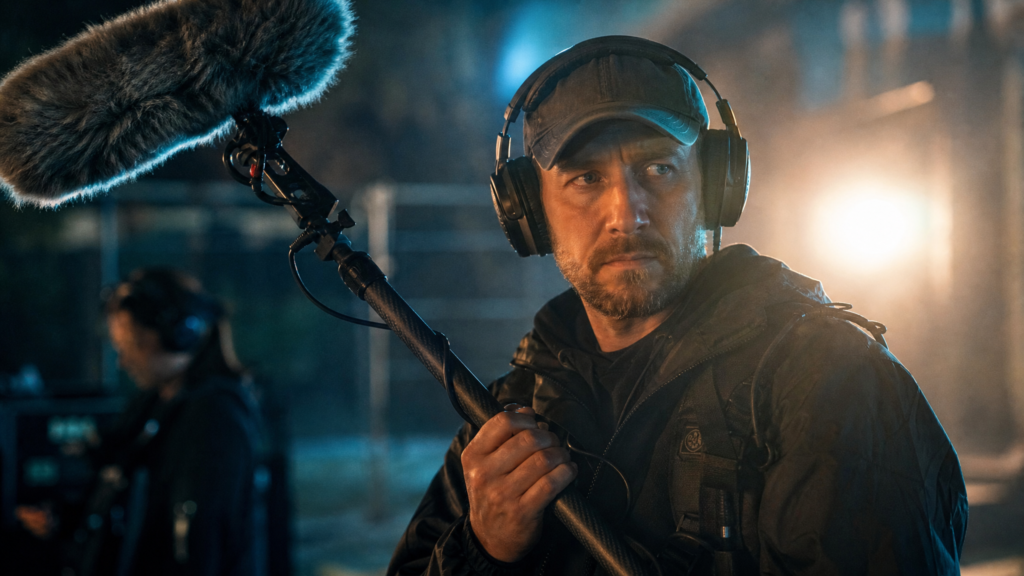
There is an ironclad law in filmmaking: “Visuals dictate the floor of your film, but audio dictates its ceiling.” Many novice creators spend fortunes on 8K cameras, anamorphic glass, and color grading, yet their projects still suffer from a cheap “amateur short” feel. The flaw lies in what remains unseen: sound. While visuals present a bounded two-dimensional frame, audio constructs three-dimensional physical reality and emotional pressure. This article explores the physics of set recording, Foley reconstruction, room tone stitching, and the cinema psychology of audio-visual counterpoint.
1. Audio-Visual Psychology: The Brain as an Audio Purist
Why are audiences far more forgiving of visual flaws than audio glitches?
When video footage is grainy, stylized, or poorly lit, the human brain automatically categorizes it as “vintage vibe” or “documentary realism.” However, if that same video suffers from unbalanced dialogue, harsh clipping, or hollow room echo, the brain experiences immediate physiological rejection, labeling the production as “cheap.”
- Visual Limitations: Human eyes focus on a narrow 120-degree arc forward, heavily restricted by the edge of the frame.
- Auditory Omnidirectionality: Hearing is 360-degree ambient sensing. Audio signals penetrate directly to the brain’s limbic system—the seat of emotion and memory—triggering instinctual fear, tension, or comfort far faster than visual reasoning.
2. Production Sound Physics: Shotgun vs. Lavalier Mics
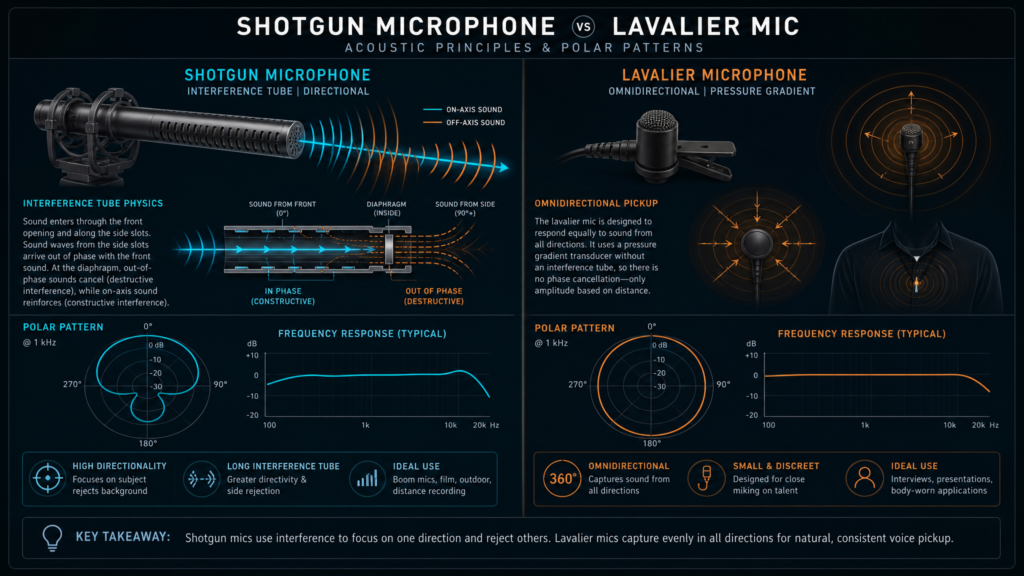
Escaping cheap production quality starts by ditching camera-mounted microphones and choosing the right pickup tools on set.
| Microphone Type | Acoustic Physics | Pros & Optimal Use Cases | Physics Pitfalls |
|---|---|---|---|
| Shotgun Mic(Interference Tube) | Uses a slotted interference tube to cancel off-axis sound waves via phase cancellation, creating a narrow supercardioid pattern. | Natural acoustics, rich airiness, accurate spatial depth. The gold standard for outdoor boom operation. | Indoor Disaster: In untreated small rooms, wall reflections enter the side slots causing phase cancellation, making voices hollow and muddy. |
| Lavalier Mic(Omnidirectional) | Omnidirectional capsule placed close to the chest to achieve high signal-to-noise ratio via inverse-square law proximity. | High SNR, isolates dialogue in noisy environments. Ideal for documentary and dynamic talent movement. | Loss of Space: Dialogue sounds overly dry with zero spatial perspective; highly vulnerable to clothing rustle noise. |
3. Post-Production Audio Stitching: Foley & Room Tone Magic
Most sound you hear in cinema was never recorded on set.
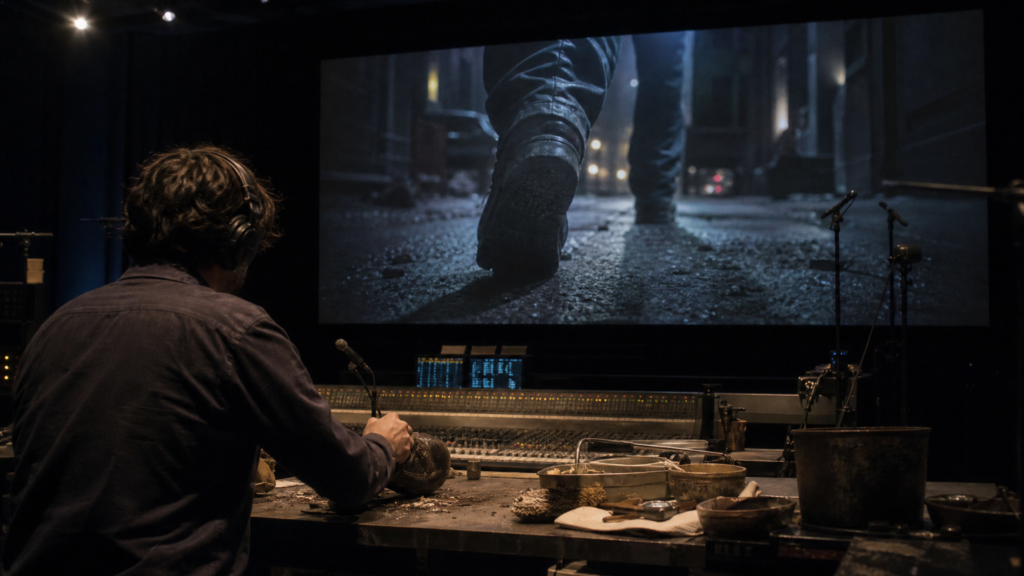
Production sound prioritizes pristine dialogue isolation, stripping away footsteps, wardrobe rustle, and subtle foliage contact. To breathe tactile life back into the frame, post-production audio design intervenes:
- The Art of Foley: In specialized Foley studios, artists watch the screen while crunching celery to emulate breaking bones, snapping leather jackets, or walking on cornstarch to recreate footsteps in snow.
- Room Tone (Eliminating Audio Cliffs): Cutting dialogue leaves dead silence between edits, creating jarring “audio cliffs.” Professional crews record 60 seconds of pure silence (“Room Tone”) on set to lay under the edit timeline, seamlessly stitching cuts together.
4. Cinema Psychology: Parallel Sound vs. Audio-Visual Counterpoint
At its highest level, sound ceases to be a slave to picture and becomes an independent psychological force.
- Parallel Sound: Audio matches visual reality (e.g., seeing a gun fire, hearing a gunshot). Establishes basic narrative reality.
-
Audio-Visual Counterpoint: Sound deliberately contradicts visual information.
- Example: A brutal war battle paired with an elegant, serene classical symphony; or a peaceful family dinner accompanied by subtle, ominous mechanical ticking and heavy breathing.
- Psychological Effect: This friction creates deep subconscious discomfort and dramatic irony, manipulating audience tension without visual exposition.
- J-Cuts and L-Cuts: Leading audio ahead of a scene transition (J-Cut) pulls the audience forward like an invisible hook; extending audio past a cut (L-Cut) leaves emotional resonance in the air.
Summary:
Audio in filmmaking is like the structural steel hidden inside a building—unseen by the audience, but if it fails, the entire structure collapses. Creators often obsess over higher resolution and costlier cinema glass while ignoring that sound is the primary weapon penetrating straight to the brain’s emotional core. From selecting shotgun versus lavalier physics on set to weaving immersive Foley soundscapes and manipulating subconscious tension via audio-visual counterpoint, true cinematic elegance is never a visual parlor trick, but the seamless synthesis of sight and sound.