

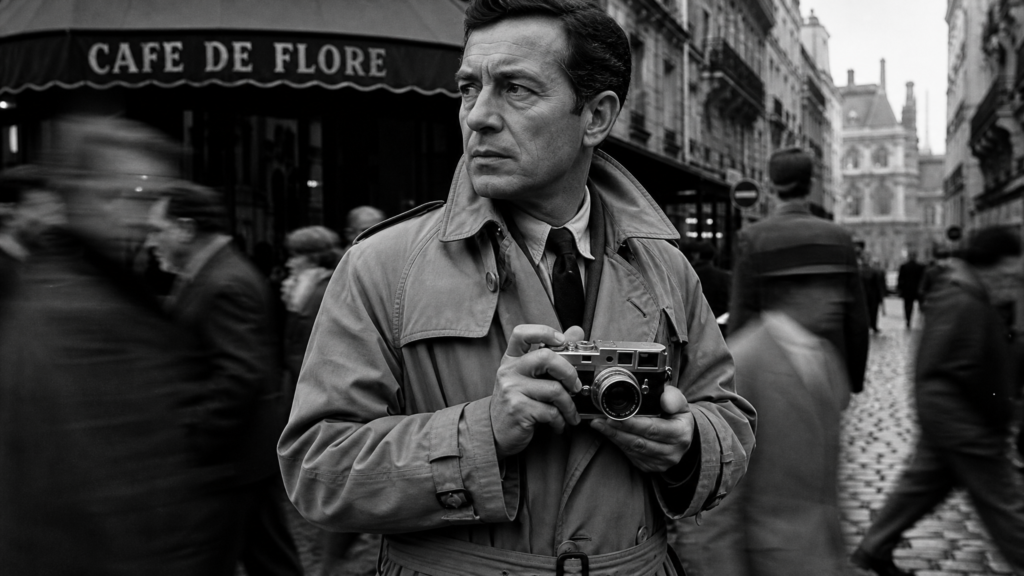
Mention Henri Cartier-Bresson, and every photographer instantly thinks of his golden rule: “The Decisive Moment.” When that man leaping over a puddle was a mere millisecond from touching the water, Bresson clicked the shutter.
Modern beginners, clutching mirrorless cameras equipped with blazing-fast phase detection and AI eye-tracking, often wonder: In an era of purely mechanical, manual-focus rangefinders, how did the masters focus so fast? Did they possess superhuman reflexes?
The blunt truth is: He wasn’t focusing at all.
Today, we skip the mysticism and dive into the physics. Let’s expose the ultimate “blind fire cheat code” of the masters—Hyperfocal Distance and Zone Focusing. We’ll explore how they used small apertures to turn precise optical instruments into foolproof, focus-free point-and-shoot cameras for the streets.
1. The Optical Cheat Code Behind the “Decisive Moment”
Human reaction time has its limits. If you spot a sudden event on the street, raise your camera, turn the focus ring, confirm the rangefinder patch alignment (or split-prism), and then press the shutter—that process takes at least 1 to 2 seconds. The true “decisive moment” is usually gone in half a second.
Documentary street masters knew this. Legendary photographer Arthur Fellig (Weegee) left behind a brutally practical street photography mantra: “F/8 and be there.” This phrase reveals the ultimate technical secret of the street: Abandon the act of focusing, and use Depth of Field (DoF) to cover everything.
This is the physical foundation of the “Hyperfocal Distance”: When a lens is focused at a specific hyperfocal distance, everything from half that distance extending to infinity is acceptably sharp. This means that as long as your subject steps into this “zone of sharpness,” you don’t even need to look through the viewfinder. You just fire the shutter. No missed focus.
2. The Physics of Hyperfocal: Reading the Vintage “DoF Scale”
If you pick up a classic Leica M-mount manual lens, or any vintage SLR lens, you’ll notice a symmetrical row of numbers engraved below the focus ring. This is the Depth of Field Scale, a brilliant physical tool that has largely vanished from modern autofocus lenses.
How do you activate the Hyperfocal hack in one second?
- Stop down the aperture: Set your aperture to f/8 or f/11.
- Align to Infinity: Turn the focus ring so the “∞ (Infinity)” symbol aligns perfectly with the “8” or “11” mark on the DoF scale.
- Read the Zone: Now, look at the corresponding “8” or “11” mark on the opposite side of the scale. It will point to a specific distance (let’s say, 1.5 meters).
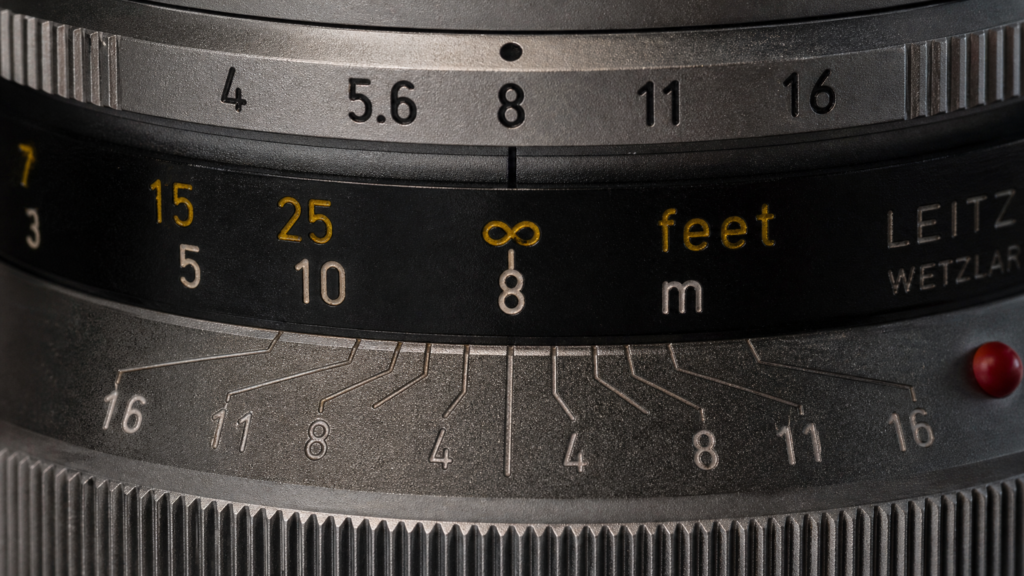
The magic is complete! Your camera is now in a hyperfocal state. At f/8, everything from 1.5 meters away from you all the way to the moon (infinity) is in focus. You can hang the camera on your chest and “shoot from the hip” at anything beyond 1.5 meters. The shutter lag is absolute zero.
3. Zone Focusing: The “Bear Trap” of the Streets
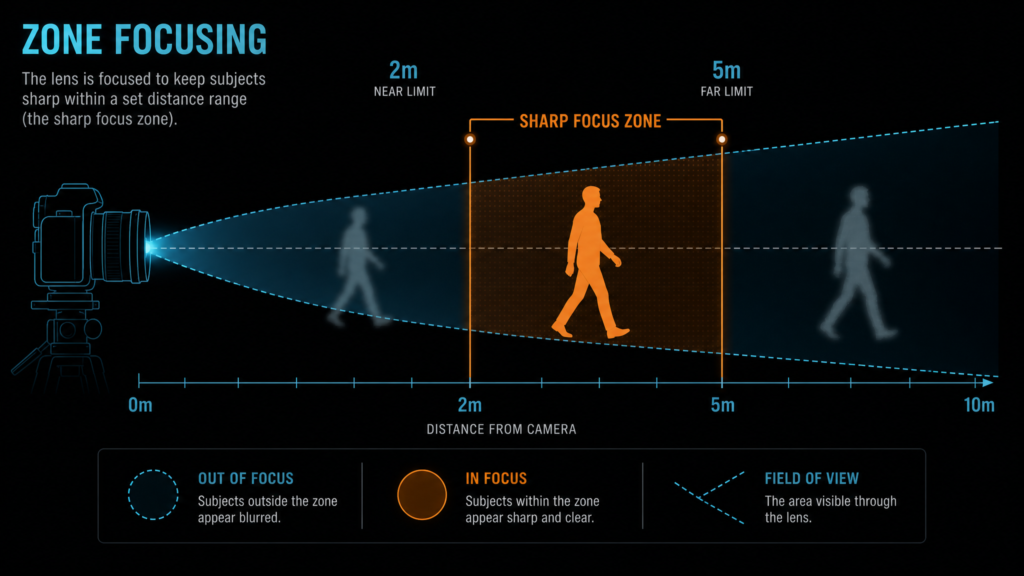
While hyperfocal distance aims to cover infinity, street photography often happens in tight alleys or dense crowds where the background is cluttered. Here, the masters used an advanced application: Zone Focusing.
Instead of including infinity, they set a “trap zone.” For example, aligning the f/8 marks on the DoF scale to cover the space between 2 meters and 5 meters. This essentially lays down an invisible 3-meter-deep “bear trap” on the sidewalk. As soon as the prey (a pedestrian) steps into that 2 to 5-meter range, the photographer raises the camera and shoots. No lens hunting, no back-focusing—just the instantaneous freezing of light and shadow.
4. Modern Homage and Digital Reflections
Today, in an era where we obsess over how many cross-type AF points our cameras have and how many calculations they perform per second, we are ironically more prone to missing the moment. All autofocus systems inherently must “hunt” for focus, introducing an inevitable lag.
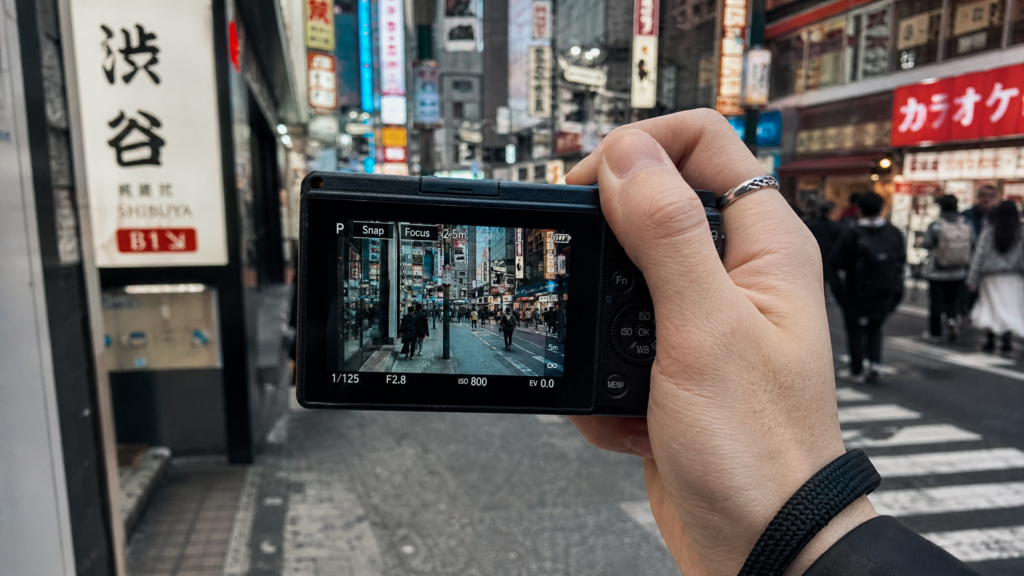
Fascinatingly, modern manufacturers who truly understand street photography still pay homage to this ancient physical hack. The highly acclaimed “Snap Focus” feature on the Ricoh GR series is essentially a digital button that instantly sets a 2-meter or 5-meter Zone Focus trap. When fully pressed, it bypasses the AF motor entirely, beating the autofocus speed of any flagship mirrorless camera.
The more advanced technology becomes, the lazier we get, relying on algorithms. But the essence of photography is controlling light and internalizing your tool via physics. Only when you understand the hyperfocal distance do you truly understand the streets.
Summary:
Technological progress constantly attempts to make us lazy, using algorithms and motors to compensate for the spatial awareness a photographer ought to possess. Yet, the laws of physics remain the most reliable foundation of the imaging world. Hyperfocal distance and zone focusing were never compromises made by an older generation lacking technology; they are a highly advanced form of control. By understanding optics, these masters actively wrested control away from the machine, achieving true “zero-lag” capturing. Take a manual lens with a DoF scale to the streets just once—that instant, algorithmic-free connection between your eye and the shutter is the most primal, hardcore romance of photography.