

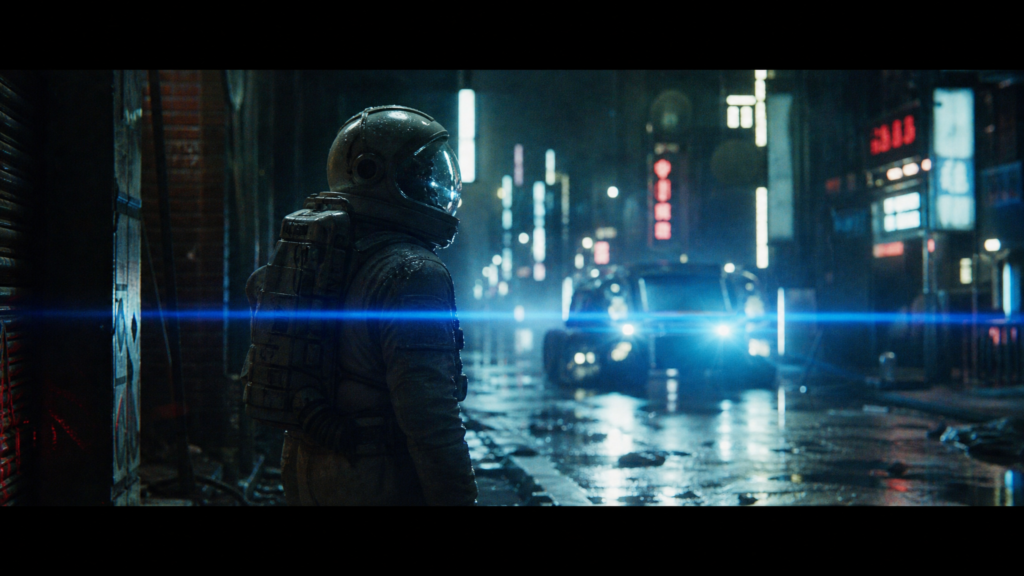
Pause Blade Runner, Alien, Star Trek, or almost any mega-budget Hollywood sci-fi blockbuster, and three unmistakable visual signatures immediately jump off the screen: an ultra-wide 2.39:1 canvas, vertically stretched oval bokeh melting into the background like a waterfall, and razor-sharp blue horizontal lens flares streaking clean across the frame.
Many novice video editors assume that slapping black letterbox bars onto standard 16:9 footage and dropping a digital flare overlay on top instantly creates a “cinematic look.” Yet place real anamorphic footage side by side with cropped spherical footage, and even an untrained eye can sense the difference immediately.
Today, we dissect cinema’s most coveted—and ironic—optical magic: the Anamorphic Lens. The punchline of film history is that this visual aesthetic worshipped by modern sci-fi auteurs wasn’t born out of artistic ambition. It started as a cost-cutting compromise to save film stock, tracing its optical DNA all the way back to World War I tank periscopes.
1. Humble Origins: From WWI Tank Periscopes to Fighting Television
The physics of anamorphic cinema wasn’t invented in Hollywood, but in the trenches of World War I.
In 1916, French astronomer and optical physicist Henri Chrétien engineered a specialized cylindrical lens called the Hypergonar to solve a deadly problem: tank crews had dangerously narrow fields of view. Chrétien’s glass horizontally squeezed a massive 180-degree panorama into a tiny periscope slit, then optically de-squeezed it inside the tank for the driver.
Fast forward to the 1950s. Hollywood was facing an existential crisis: the rise of television. Families were staying home to watch free 4:3 broadcasts, leaving movie theaters empty. Studio executives realized that to lure audiences back, cinema had to deliver an epic spectacle living room TVs could never replicate—ultra-widescreen.
However, switching to wider 70mm film stock meant forcing tens of thousands of theaters worldwide to buy prohibitively expensive new projectors. 20th Century Fox found a genius workaround by acquiring Chrétien’s patent and launching CinemaScope:
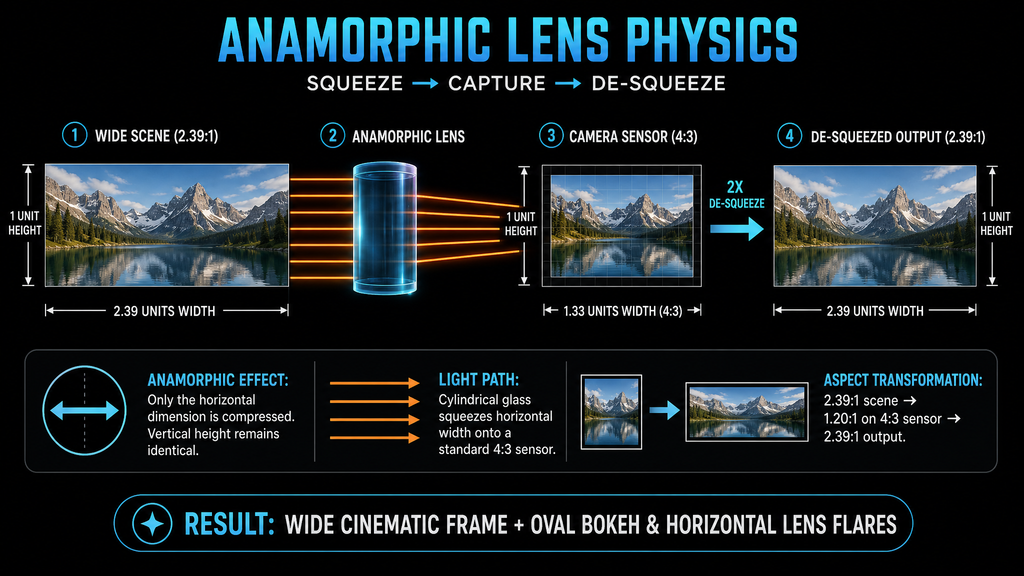
- Squeeze on Capture: Place cylindrical anamorphic elements in front of standard 35mm film, horizontally compressing a 2x wider image onto a regular film frame (making actors look tall and skinny on the negative).
- De-squeeze on Projection: Mount a matching reverse anamorphic lens onto the theater projector to stretch the image back out by 2x onto a massive curved screen.
Without inventing a new film gauge, Hollywood conjured the iconic 2.39:1 epic canvas. At its core, it was a brilliant financial hack.
2. How Optical “Flaws” Became Cinema’s Gold Standard
By traditional optical engineering metrics, vintage anamorphic lenses were deeply flawed—prone to distortion, soft edges, and stray light reflections. Yet after seventy years of theatrical conditioning, audiences’ brains permanently hardwired these exact optical imperfections as the visual language of “high-budget cinema.”
| Optical Trait | Spherical Lens | Anamorphic Lens |
|---|---|---|
| Glass Geometry | Symmetrical spherical elements; identical refractive power horizontally and vertically. | Asymmetrical cylindrical elements that compress light exclusively along the horizontal axis. |
| Out-of-Focus Bokeh | Clean circular highlights (slight cat’s-eye near edges). | Vertically stretched Oval Bokeh, creating a painterly, “waterfall” background falloff. |
| Lens Flare | Circular ghosts, polygons, or soft veiling haze. | Razor-sharp Horizontal Streak Flares cutting across the entire frame (typically blue or amber). |
| FOV vs. Depth of Field | Wide field of view inherently produces deeper depth of field. | Optical Cheat Code: Combines the horizontal width of a wide-angle lens with the shallow DoF and compression of a telephoto. |
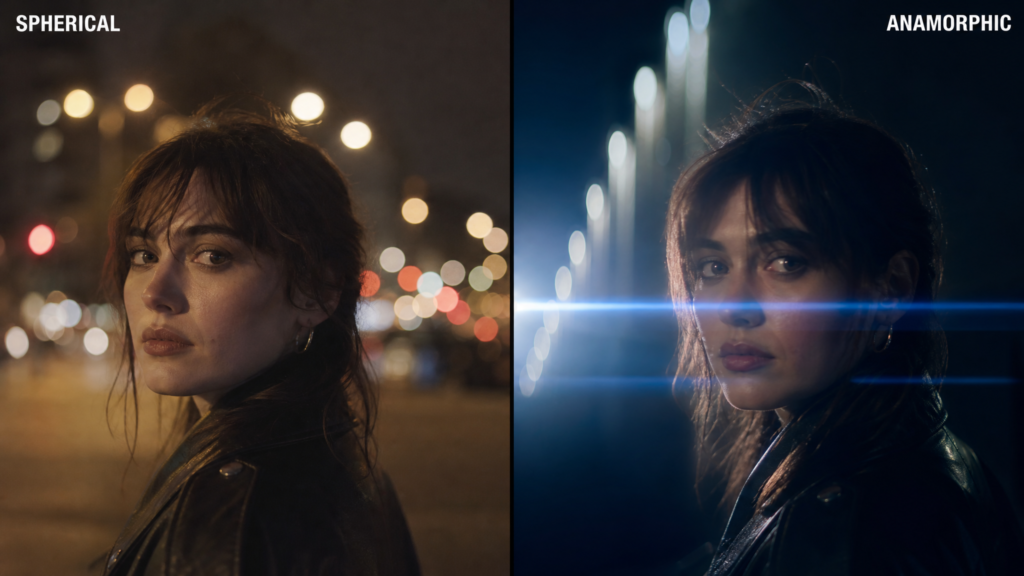
- The Physics of Oval Bokeh: Because cylindrical glass compresses the horizontal axis by 2x (or 1.33x, 1.5x, 1.8x in modern variants), circular out-of-focus highlights hit the sensor squeezed horizontally. When the footage is horizontally de-squeezed in post-production, foreground subjects return to normal proportions, while out-of-focus specular highlights stretch vertically into signature ovals.
- Why Sci-Fi Directors Worship Horizontal Flares: When intense light hits a cylindrical lens element, internal reflections scatter perpendicular to the cylinder’s axis, firing a dramatic streak straight across the screen. In the late 1970s, Ridley Scott intentionally aimed harsh industrial ship lights directly into vintage Panavision anamorphics on Alien and Blade Runner. Later, Steven Spielberg and J.J. Abrams (Star Trek) elevated horizontal streaks into the ultimate shorthand for futuristic scale. These flares hint at unseen, high-energy light sources just outside the frame—giving sterile CGI and sci-fi sets an organic, tactile sense that a real camera is physically present in that world.
- A Quirky Footnote — “Anamorphic Mumps”: Early anamorphic lenses suffered from squeeze-ratio drop-off at close focus distances. When an actor stepped in for a close-up, the lens compressed less horizontally, causing their face to look unnaturally wide once de-squeezed—nicknamed “anamorphic mumps.” Panavision eventually solved this with complex interlocking floating astigmatizer elements, earning an Academy Award for technical achievement.
3. Why Cropping 16:9 with Black Bars Never Fools a Trained Eye
Many emerging filmmakers assume that shooting standard 16:9 spherical footage and dropping 2.39:1 black bars in DaVinci Resolve delivers the same widescreen magic.
Physically, letterboxing is subtraction, while anamorphic is expansion:
- Resolution Loss: Cropping a 16:9 frame throws away roughly 25% of your sensor’s vertical pixels for nothing.
- Unfakeable Spatial Separation: Here lies the true superpower of anamorphic glass. A 50mm 2x anamorphic lens maintains the vertical perspective, facial compression, and shallow depth of field of a 50mm lens, yet captures the sweeping horizontal field of view of a 25mm wide-angle lens. You get wide-angle environmental scope paired with telephoto subject isolation. No crop bar or digital plugin can physically replicate that surreal three-dimensional pop.
4. Digital Democratization: Practical Advice for Modern Creators
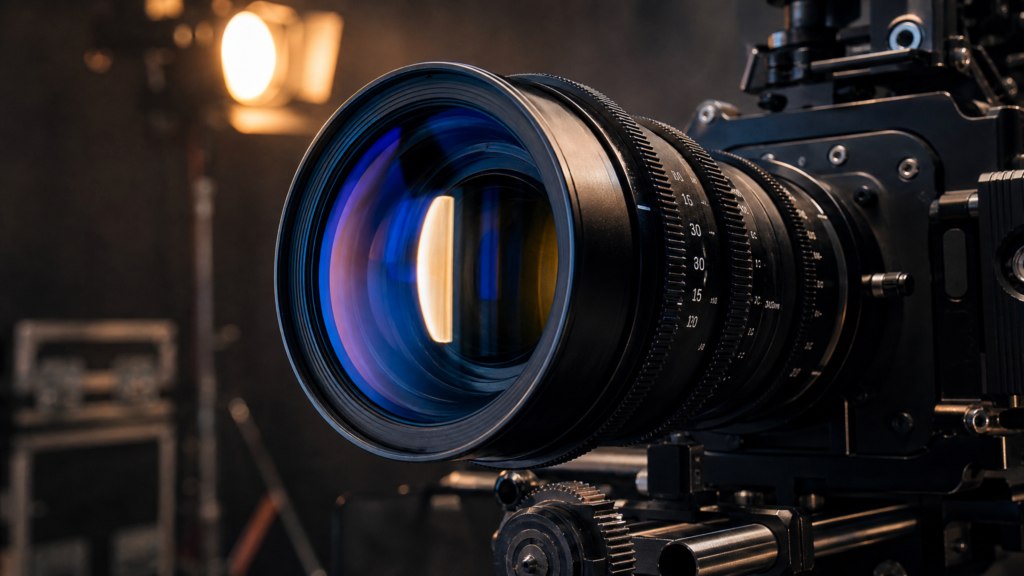
In the film era, renting a set of Panavision C-Series or Cooke Anamorphic/i lenses cost as much as a luxury car and weighed a small fortune. Today, modern mirrorless cameras featuring Open Gate (full 3:2 or 4:3 sensor readout) paired with affordable modern anamorphic glass (from brands like Sirui, Laowa, Blazar, and Atlas) have placed true widescreen physics into the hands of indie filmmakers.
The Editor’s Practical Warning: When you mount your first anamorphic lens, resist the temptation to shine flashlights straight into the glass on every single shot. Flares and oval bokeh are spices designed to heighten emotion, scale, or isolation. If a casual café vlog or corporate interview is drowning in blinding blue laser streaks, it doesn’t look like Blade Runner—it just looks like visual pollution.
Summary:
Cinema history is built on brilliant accidents. Whether it was 24fps born to save celluloid costs, or anamorphic widescreen borrowed from WWI tank periscopes to survive the rise of television, the industry’s most iconic aesthetics often began as pragmatic engineering compromises. Yet it is precisely these optical “imperfections”—the waterfall oval bokeh, subtle edge distortion, and streaking horizontal flares—that elevate cinema beyond cold reality into a dreamlike visual language. Understanding anamorphic physics reminds us that true cinematic presence can never be faked with black letterbox bars; it is sculpted optically through light, space, and intention.