

Why Are the Stripes Black and White?
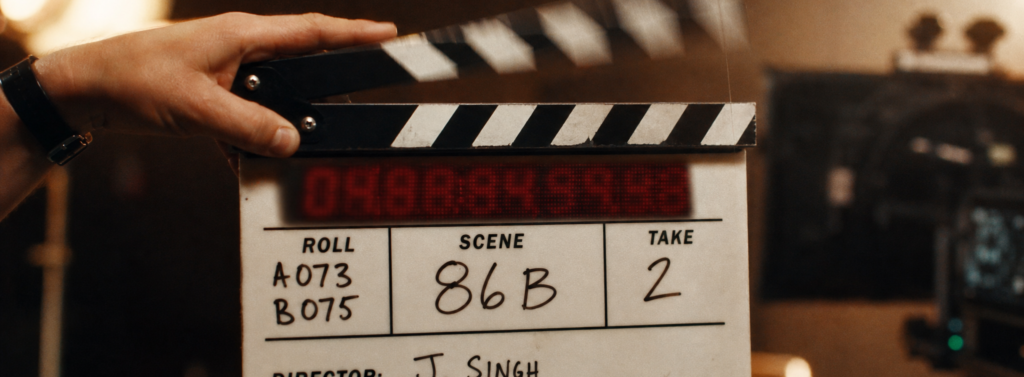
Every time you watch behind-the-scenes footage, the moment that always steals the spotlight is the same: a clapper loader holds up a black-and-white striped board in front of the camera, yells “Action,” snaps the board shut with a sharp clap, and steps out of frame with a flourish.
Most people watching that clip reach for words like “cool,” “professional,” or “cinematic ritual.” But ask an actual clapper loader why that board exists, and you won’t get an aesthetics lecture. You’ll get a straight answer: this seemingly casual piece of wood is the last line of defense for whether sound and picture will actually line up. Every stripe, every letter printed on it is the product of decades of the film industry hitting the same wall over and over, then engineering its way out.
1. Why Were Sound and Picture Ever Separated in the First Place?
To understand the clapperboard, you need to grasp something most people never think about: for most of film history, sound and picture were recorded on two completely independent machines.
This workflow is called Double-System Recording. The camera captures picture. A separate recorder — magnetic tape in the early days, digital recorders later — captures sound. Neither knows the other exists during the shoot. Only later, on the editing bench, does someone have to stitch them back into a single timeline.
That sounds inconvenient, but the payoff is real: the sound recordist can use the best microphone in the cleanest position, unshackled from the camera body. The camera, in turn, isn’t burdened by a bulky synchronization motor and stays light enough for handheld and moving shots. This split workflow has survived from the early sound-film era all the way to today’s digital productions.
The obvious problem follows: with two independently recorded streams, how does an editor know which frame of picture matches which second of sound? Before precise timecode existed, editors faced hundreds of unmarked reels of film and tape, with matching them by eye alone being close to impossible. The clapperboard exists to solve exactly that problem.
2. Black-and-White Stripes: A Coordinate System for Bad Eyes and Bad Footage
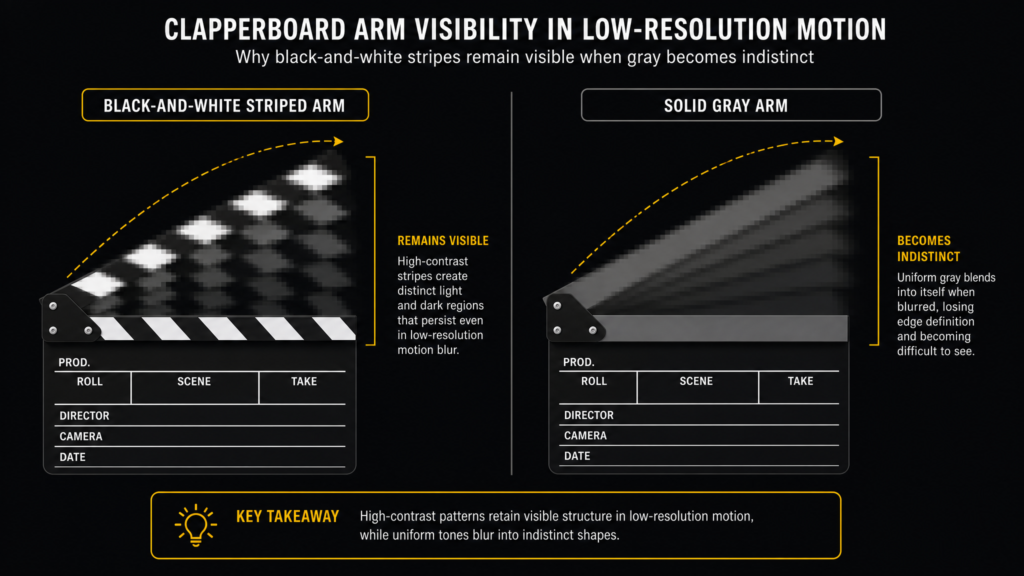
The most eye-catching feature of a clapperboard is its diagonal black-and-white stripes. Most assume this is purely for visibility — but the real design intent was to fight the technical limitations of the era head-on.
Early film stock had far lower resolution and dynamic range than today, and camera viewfinders rendered images crudely. Under those conditions, a solid-colored clapper arm would blur into an indistinct smear during playback — an editor would have no reliable way to pinpoint the exact frame where the arm fully closed.
The black-and-white stripes exist to create maximum contrast. Black and white represent the largest possible difference in luminance between any two colors, and that extreme contrast remains legible even on low-resolution, low-fidelity film. The denser the stripe pattern, the more the closing motion of the arm produces a visible “strobing” effect frame by frame — letting an editor pinpoint precisely when the black and white blocks fully align.
In other words, the stripes were never an aesthetic choice. They’re a high-contrast coordinate system engineered specifically for poor imaging conditions, designed to leave motion blur nowhere to hide.
3. That “Clap” Is the Real Technical Core
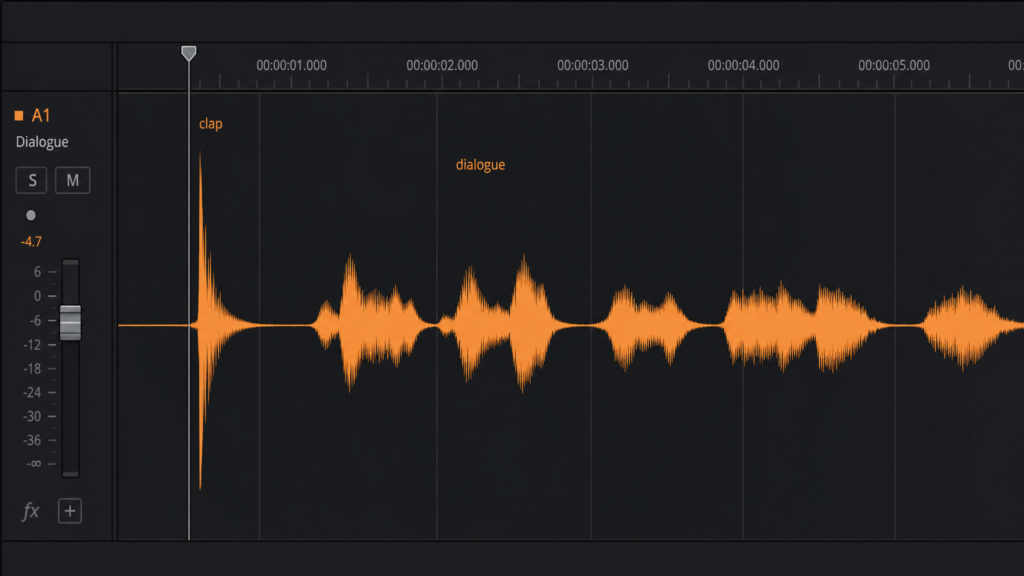
If the stripes solve the “which frame” problem for picture, the sharp clap sound produced when the arm slams shut solves the equivalent problem for sound — and it’s arguably the more elegant piece of engineering in the whole system.
Open the recorded audio track in any editing software, and it renders as a rolling waveform. Ordinary dialogue and ambient sound produce continuous, undulating curves with no single unambiguous point to align to.
But the clap itself is an extremely short, extremely sharp impact sound. Acoustically, this produces a near-vertical transient spike in the waveform, standing in stark contrast to the gentler sound around it — instantly identifiable even among hundreds of audio tracks.
The syncing logic that follows is almost brutally simple: the editor scrubs frame-by-frame through the picture to find the exact frame where the striped arm is fully closed, and marks the timeline there. Then, on the independently recorded audio track, they locate that sharp transient spike and align it to the same point. Once those two markers overlap, sound and picture are welded to the same timeline.
This is also why a clean, sharp clap matters so much on set. The faster and crisper the arm closes, the sharper both the visual edge and the audio spike become — and the more precise the eventual sync.
4. Why Hasn’t the Clapperboard Been Replaced in the Digital Era?
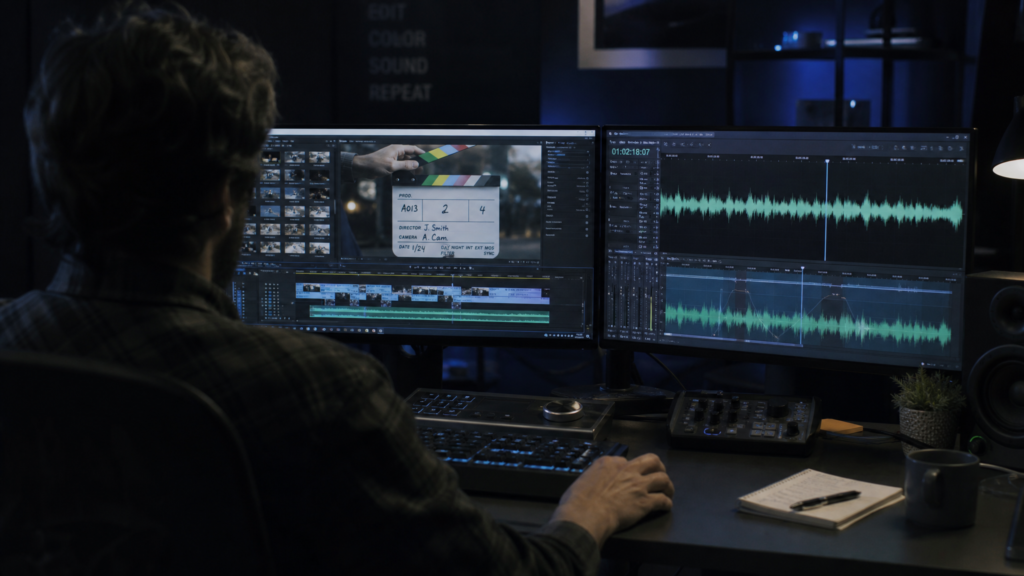
Here’s the interesting part: modern cameras and audio recorders already have built-in timecode accurate to the millisecond. In theory, two devices only need to “jam sync” their timecode once, and every subsequent clip should align automatically via metadata — no manual clapping required.
And yet walk onto any professional set today, and you’ll still see a clapper loader marking every single take. The reason is simple: no matter how precise a timecode system is, it can drift or fail entirely — due to a device restart, a battery swap, or clock drift between units. The closed frame and the audio spike left behind by a physical clapperboard are a verification record completely independent of any electronic system. Even if every piece of timecode metadata falls apart, an editor can still resync sound and picture by eye and ear alone.
This is also why the board is covered in scene number, take number, roll number, and date. It isn’t just a syncing tool — it’s an ID card for every single clip that travels with the footage through the entire post-production pipeline.
Reflections
The clapperboard is far more than a ceremonial piece of set theater; it is a masterclass in solving high-precision engineering problems at the lowest possible cost. Requiring no power, no software, and no smart devices, a painted piece of wood and a sharp physical impact are enough to achieve frame-accurate synchronization across thousands of clips. The “dumb but unbreakable” nature of this physical redundancy is precisely why it hasn’t been completely replaced by digital timecode. As technology advances and points of failure multiply, the clapperboard reminds us that the most dependable tools are rarely the flashiest—they are the ones with the simplest logic and the fewest dependencies.