The Alchemy of Color: From Chemical Reactions to Digital Code, A Century of Evolution in Video Image Quality
19/05/2026
Share
From Chemical Reactions to Digital Code, A Century of Evolution in Video Image Quality
When we talk about the evolution of video quality, the conversation is often hijacked by the relentless pursuit of resolution—from Standard Definition to HD, and now the dizzying heights of 4K and 8K. But ask any seasoned cinematographer or colorist, and they will tell you a different truth: the soul of the true “cinematic look” rarely lies in the sheer number of pixels. It resides in the dynamic range, the highlight roll-off, and above all, the color science.
Over the past century, the way we capture and process the colors of the world has undergone a profound metamorphosis. It has evolved from an unpredictable “chemical alchemy” in darkrooms to a precise “mathematical science” on our computer screens. Let us explore how the underlying logic of image quality has shifted from the physical era to the digital age.
The Film Era: The "Sensory Beauty" Bound by Chemistry
In the analog era, capturing an image was a purely physical and chemical process. The fundamental recording medium was silver halide crystals coated on a celluloid strip. In those days, “color science” was not a software algorithm; it was literally a chemical recipe.
When a director chose a specific film stock, they were essentially locking in the aesthetic of the entire movie. Kodak stocks were famous for their warm, rich reds and yellows, making them a staple for classic Hollywood skin tones. Fujifilm, on the other hand, was renowned for its cooler, magenta-green biases, offering a distinctively different emotional undertone.
The most irreplaceable magic of film, however, was its Highlight Roll-off. When celluloid film is overexposed by strong light (like the sky or a bright practical lamp), it doesn’t just abruptly turn white. The chemical crystals react gradually, creating a soft, pleasing gradient as the highlights fade into pure white. This natural, physical characteristic created a smooth tonal transition that defined the luxurious “cinematic look” of the 20th century.
The unique chemical properties of analog film naturally create a soft, pleasing gradient in overexposed areas, a phenomenon known as highlight roll-off. (AI-generated image)
The Digital Growing Pains: Resolution Rush and the "Plastic Look"
As the industry transitioned from analog to digital, it entered a painful, awkward phase. Yes, the images became sharper and free of physical dust and scratches, but early digital video was widely criticized for feeling “cheap” and “plastic.”
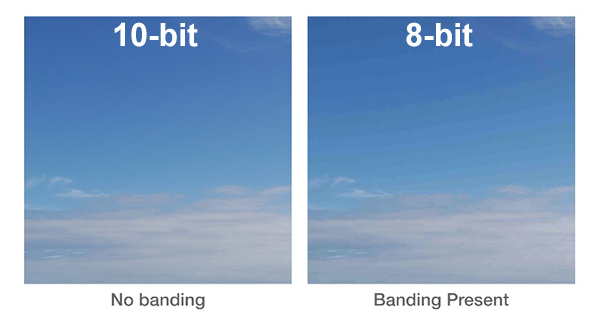
The culprit was the limitation of early digital color depth and sensor latitude. Early digital cameras often recorded in 8-bit color, meaning they could only capture 256 shades per color channel. When filming a vast blue sky or a smooth gradient, the camera simply didn’t have enough data to render the subtle transitions, resulting in ugly, visible steps of color known as Color Banding.
Worse still was the digital sensor’s response to light. Unlike film’s graceful highlight roll-off, early electronic sensors operated on absolute mathematical thresholds. Once a pixel reached its maximum light capacity, it hard-clipped. The information was instantly destroyed, leaving a block of dead, detail-less white. This harsh, unforgiving transition between light and shadow is exactly what gave early digital footage its notorious “video look.”
Early digital sensors often suffered from color banding due to limited 8-bit depth, causing harsh, visible steps in smooth gradients like skies. (Image from internet)
The Digital Peak: Latitude, Log, and Full-Pipeline Color Science
The true turning point for digital cinema arrived when engineers stopped trying to bake the final look directly into the camera and instead focused on maximizing data capture.
From “Baked-in” to “Raw Data”: The introduction of RAW video formats and logarithmic gamma curves (Log profiles, such as S-Log, C-Log, or D-Log) revolutionized the workflow. Modern professional cameras no longer hard-code contrast and saturation into the video file. Instead, they compress the maximum possible dynamic range and grayscale information into a flat, desaturated, grayish image. This preserves details in both the deepest shadows and the brightest highlights, handing absolute control over to the post-production stage.
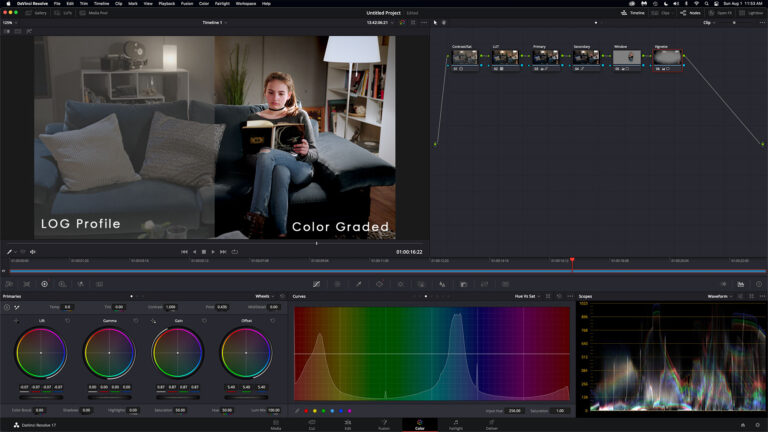
The Rise of the Digital Darkroom: The complex chemical vats of 20th-century film labs have been replaced by the intricate node trees of modern grading software like DaVinci Resolve. Working with massive 10-bit or 12-bit data streams, today’s colorists utilize Color Space Transforms (CST) and precise mathematical matrices. They can isolate specific hues, manipulate shadows without affecting mid-tones, and apply LUTs (Look-Up Tables)—the digital equivalent of film simulation filters—to craft visual tones with surgical precision.
Modern grading software like DaVinci Resolve allows colorists to manipulate flat Log footage (left) into a vibrant final image (right) with surgical precision using complex node trees. (Image from internet)
The Cycle of Aesthetics: From Extreme Sharpness to "Recreating Flaws"
Today, modern digital sensors are engineering marvels. They can capture impeccably clean, razor-sharp images even in near-total darkness. Yet, a fascinating paradox has emerged in modern high-end commercial and film post-production.
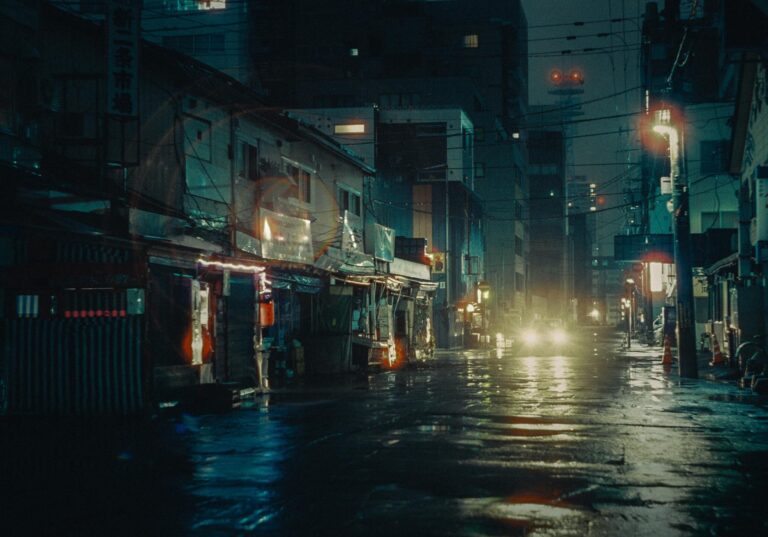
Why do today’s top colorists spend hours in software intentionally degrading this perfect digital image by adding Film Grain, Halation (the red glowing bleed around bright highlights), and Bloom effects?
This points to a profound truth about human visual aesthetics. We have developed visual fatigue towards pure, sterile “electronic perfection.” Subconsciously, we associate extreme digital sharpness with clinical broadcasts or amateur videography. To evoke emotion and nostalgia, we now use massive computational power to artificially recreate the beautiful, unpredictable “flaws” of the physical film era. We are using the ultimate digital tools to simulate the analog soul.
Today's top colorists often intentionally add film grain, bloom, and halation (the red glow around the streetlights) to digital footage to evoke nostalgia and cinematic warmth.(Image from internet)
Editor's Note: The True Value of Color
The evolution of video technology has democratized image quality. Today, capturing “accurate” and “clean” colors is easier and cheaper than ever before.
However, visual accuracy does not equal emotional resonance.
A perfectly white-balanced, noiseless shot might be technically flawless, but it can also be incredibly boring. Whether we are dealing with chemical emulsions or digital 1s and 0s, the camera remains just a tool. The true alchemy of color lies in understanding color psychology—knowing when to push the shadows into a cold, isolating teal, or when to bathe the highlights in a nostalgic, comforting warmth.
Code and parameters set the baseline of your image quality, but it is the creator’s aesthetic intent and empathy that dictate the ceiling of the art.