The ARRI Reflex Revolution: How a Spinning Mirror Saved Cinematographers from Shooting Blind
10/08/2026
Share
How a Spinning Mirror Saved Cinematographers from Shooting Blind
Before ARRI invented the spinning mirror reflex shutter, cinematographers couldn’t see through the actual shooting lens, relying instead on offset viewfinders to “guesstimate” composition. This mechanical miracle from ARRI gave operators true “What You See Is What You Get” (WYSIWYG) framing for the very first time, launching a new era in cinema.
The Dark Ages: Tormented by Parallax
Today, anyone with a smartphone or DSLR expects to see their exact composition in real time. But during the golden age of cinema prior to the late 1930s, this was a distant dream.
Herculean studio cameras like the Bell & Howell 2709 or Mitchell BNC utilized side-mounted or top-mounted viewfinders (much like early rangefinder cameras). This introduced a fatal physical problem: Parallax Error.
When shooting distant landscapes, the offset between the viewfinder and the shooting lens was negligible. However, during close-ups, what the operator saw through the viewfinder diverged drastically from what the film captured. Directors of photography had to mentally compensate for the offset. Worse yet, once the shutter started running, the operator was essentially “shooting blind”—unable to verify critical focus or subtle actor framing in real time.
Checking focus required halting production to physically slide the camera body along a rack-over base, look through a dedicated alignment optical tube, and then crank the camera back into shooting position. This cumbersome routine severely constrained dynamic camera movement.
The 1937 Mechanical Miracle: The Spinning Mirror Shutter
The watershed moment arrived at the 1937 Leipzig Trade Fair. ARRI co-founders and engineers Erich Kästner and August Arnold unveiled the legendary ARRIFLEX 35.
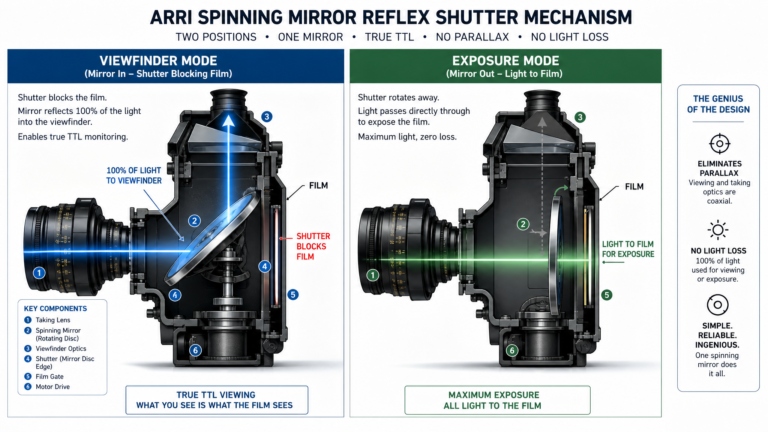
The secret behind this masterpiece was an ingenious Spinning Mirror Reflex Shutter angled at 45 degrees:
When the shutter closed off the film plane: The mirrored surface reflected 100% of the light coming through the camera lens straight into the optical viewfinder eyepiece.
When the mirror rotated out of the way: Light passed directly onto the film frame for exposure.
Spinning at 24 revolutions per second, persistence of vision allowed the operator to see a seamless, flicker-free live image. For the first time in history, cinematographers possessed true Through-The-Lens (TTL) monitoring while actively exposing film.
This mechanical design was brilliant in its simplicity—it didn’t use beam-splitters that stole precious light. Instead, it repurposed the dark phase of the exposure cycle to deliver a pristine optical image to the operator’s eye.
Diagram of the Spinning Mirror Reflex Shutter mechanism. As the shutter blocks the film during exposure gaps, a 45-degree mirror redirects light into the viewfinder eyepiece; when it spins away, light hits the film directly. This brilliant mechanical design achieved true WYSIWYG without light loss.
Unchaining the Camera: Redefining Cinematic Language
The ARRI reflex shutter was not merely an engineering triumph; it triggered an aesthetic revolution.
Previously, cameras were heavy, stationary behemoths locked to massive tripods. The ARRIFLEX 35, featuring its reflex viewfinder and compact handgrip design, unchained the cinematographer.
For the first time, operators could shoulder the camera, weaving through crowd scenes with handheld agility. The raw immediacy of WWII newsreels and the fluid, kinetic visual style of the French New Wave were directly enabled by ARRI’s optical breakthrough.
Even in today’s digital era, high-end digital cameras like the ARRI ALEXA Studio retain mechanical spinning mirror shutters. The zero-latency, pure optical reality it offers remains the prized gold standard for top-tier cinematographers worldwide.
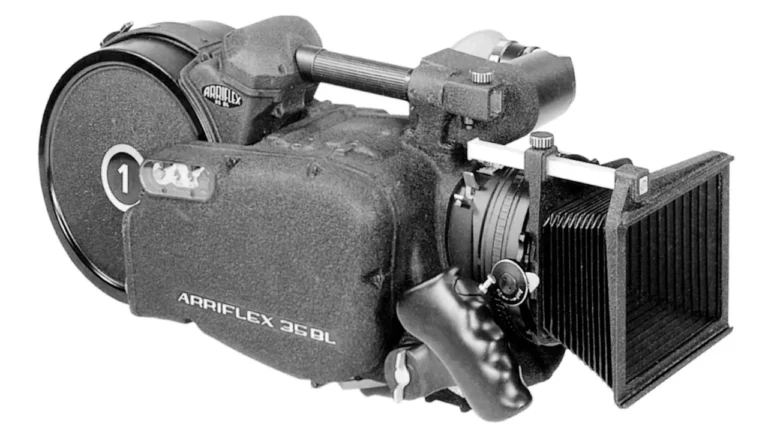
A cornerstone of the film industry: The ARRIFLEX 35 BL motion picture camera. Not only did it inherit ARRI’s proud spinning mirror reflex system, but it also pioneered internal sound blimping. It allowed cinematographers, for the first time, to shoulder the camera for fluid, handheld tracking shots while recording sync sound, completely liberating the visual language of modern cinema. (Image from internet)
The Bottom Line
A simple 45-degree spinning mirror solved a mechanical focusing issue on the surface, but fundamentally reshaped how humans observe the cinematic world. Before ARRI’s reflex shutter, cinematographers were outsiders guessing from the sidelines; after it, they became one with the lens. It liberated not only the physical placement of the camera, but the imagination of filmmakers worldwide. It proves a timeless truth: true creative freedom emerges only when technology removes the friction between human vision and artistic expression.