


The holy grail of modern gear enthusiasts: smooth, circular “bokeh balls.” A term that didn’t even exist in the Western photographic lexicon until the late 1990s. (Image from internet)
Walk onto any film set or scroll through any modern camera review, and you will inevitably be bombarded with one word: “Bokeh.”
Beginners whisper it with reverence. Gear reviewers use it to justify the outrageous price tags of f/1.2 prime lenses, describing it as “creamy,” “buttery,” or “swirly.” It sounds like a sophisticated, centuries-old optical term derived from Latin or Greek.
The reality? Up until the late 1990s, the Western photography and film world didn’t even have a specific word for it. The global obsession with “Bokeh” is entirely the result of a misspelled Japanese import.
The Western Void: Mathematics Over Aesthetics
Before the 1990s, Western cinematographers and photographers discussed the out-of-focus areas of an image in strictly mathematical or technical terms. They talked about “Depth of Field” (DoF) or simply “background blur.”
If a background was out of focus, it was just… out of focus. Western optical engineering historically prioritized the sharpness of the subject in the focal plane. The quality, texture, and character of the blurry background were often treated as an afterthought—a byproduct of the mathematical calculation of aperture and focal length. There was no dedicated vocabulary to describe whether a blur was “beautiful” or “distracting.”
The Japanese Philosophy of “Boke” (ボケ)
In Japan, however, the cultural approach to imagery was entirely different. The Japanese language had the word “boke” (ボケ), which translates to “blur,” “haze,” or a state of mental fuzziness.
Japanese optical engineers and photographers didn’t just care about the sharp subject; they cared deeply about the transition from sharp to unsharp. They evaluated the aesthetic character of the out-of-focus areas. Was the blur smooth? Did the highlights have hard, nervous edges? They categorized boke into different flavors, recognizing that the background is an active participant in visual storytelling.
The 1997 Revolution: Adding an “h” to Teach Pronunciation
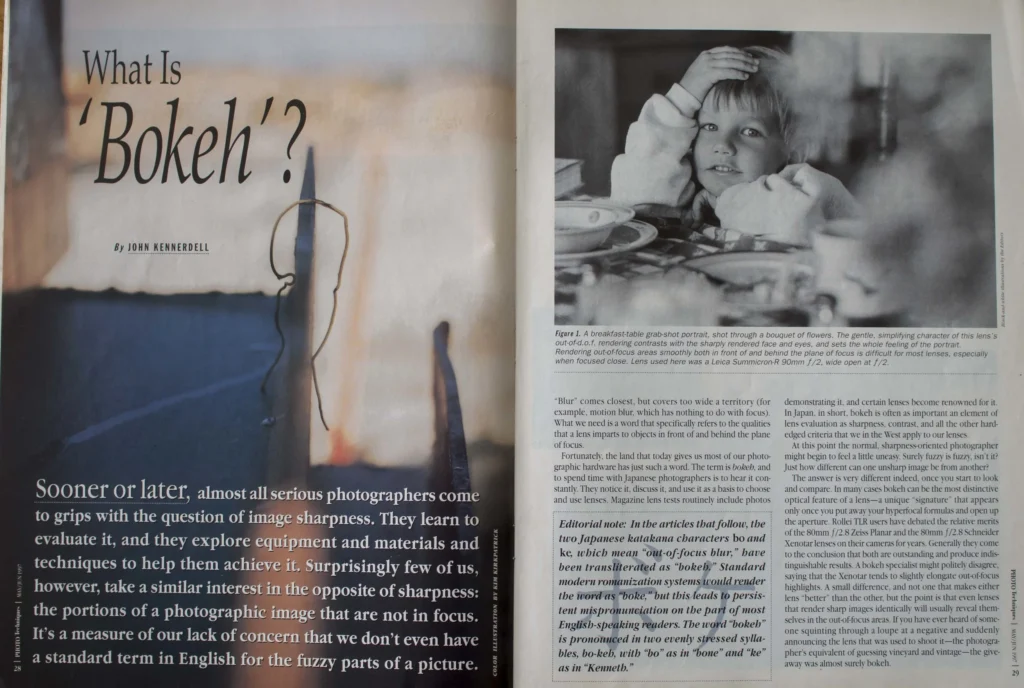
The linguistic revolution. In 1997, magazine editor Mike Johnston added an “h” to the Japanese word “boke” to help English speakers pronounce it correctly, accidentally creating a global marketing phenomenon.
So, how did this Japanese concept infect the Western world? Enter Mike Johnston, the editor of the American magazine Photo Techniques.
In the March/April 1997 issue, Johnston decided to publish a series of articles discussing this Japanese aesthetic concept. However, he faced a linguistic problem. If he printed the word as “boke,” English speakers would inevitably pronounce it to rhyme with “poke” or “joke.”
To force his American readers to pronounce it correctly with two syllables (Bo-Keh), Johnston made a brilliant, albeit historically inaccurate, editorial decision: He slapped an “h” on the end.
Thus, the word “Bokeh” was officially coined.
The Marketing Hijack
The Western photographic community, starved for a term to describe the aesthetic quality of blur, adopted the word with ferocious enthusiasm. Almost overnight, “Bokeh” became a global buzzword.
Soon, camera and lens manufacturers realized they had struck marketing gold. They hijacked the term, twisting it from a nuanced discussion about optical transitions into a brutal spec war. They began selling the idea that “more bokeh equals better imagery,” convincing millions of hybrid shooters that dropping thousands of dollars on an ultra-fast lens was the only way to achieve a “cinematic look.”
Conclusion: Blur is a Tool, Not a Story
Understanding the history of “Bokeh” strips away the mystical marketing aura surrounding modern lenses.
Our editorial philosophy remains grounded in absolute control: Do not let the obsession with “creamy bokeh” distract you from the fundamentals of cinematography. Background blur is merely a tool for subject isolation. It cannot fix terrible lighting, it cannot hide poor acting, and it certainly cannot write a compelling script. Master the narrative first, and let the bokeh serve the story—not the other way around.