The “Frame Rate Cold War”: From the Compromise of Sound Film to the Grid Split of NTSC and PAL
27/07/2026
Share
From the Compromise of Sound Film to the Grid Split of NTSC and PAL
(Image from internet)
Dive deep into the century-long grudge behind frame rates. 24 fps wasn’t just to save film; it was the absolute physical baseline tested to keep the “optical sound track” from distorting. Uncover the bizarre truth behind the PAL vs. NTSC format war: it wasn’t about advanced optical considerations, but the differing AC power grid frequencies of various countries (50Hz vs 60Hz). Finally, we decode the rise of 30fps and 60fps, and why blindly chasing high frame rates ruins the image with a cheap “Soap Opera Effect.”
The 24fps Myth: An Economic and Acoustic Compromise
For nearly a century, 24 frames per second (fps) has been worshiped as the gold standard of “cinematic look.” Many mistakenly believe this number was chosen by legendary directors for its artistic, dream-like motion blur. The reality? It was purely a capitalist and engineering compromise.
During the silent film era, frame rates were a chaotic mess, ranging anywhere from 16 to 20 fps, often hand-cranked by the camera operator. However, the arrival of sound film in 1927 changed everything. Audio was recorded directly onto the edge of the film strip as an “optical sound track.” If the film speed fluctuated, the actors’ voices would shift wildly in pitch. Engineers needed a standardized, constant speed.
Why exactly 24? Film stock was incredibly expensive. Studios wanted to use the least amount of film possible while maintaining audio fidelity. After rigorous testing, engineers discovered that 24 fps was the absolute minimum speed required to keep the optical audio track sounding natural and in pitch. The legendary “cinematic 24 frames” was born not out of art, but because 25 frames would have cost Hollywood a few extra millions.
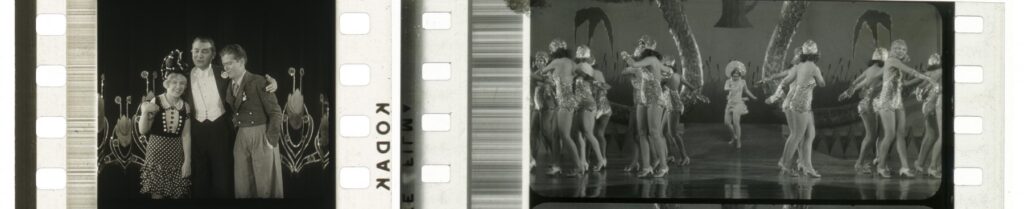
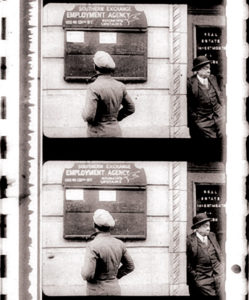
Archival scan of standard 35mm motion picture film. The jagged waveform on the left edge (inside the sprocket holes) is the "optical sound track" that determined the fate of the film industry. To ensure projectors could read this track smoothly without pitch distortion, Hollywood ultimately locked the absolute physical minimum at 24 frames per second. (Image from internet)
The Bizarre Split: NTSC, PAL, and the Power Grid
When television was invented, the frame rate war entered a new, bizarre chapter. The visual texture of a TV broadcast was entirely different from a cinema screen, leading to the infamous format war between NTSC (primarily US/Japan) and PAL (Europe/Asia).
Was this a debate over optical superiority? Not at all. It was dictated by local electricians.
Early cathode-ray tube (CRT) televisions lacked internal memory to stabilize images, so they had to sync their refresh rates directly with the local alternating current (AC) power grid to avoid severe screen flickering.
In the United States, the power grid operates at 60Hz. Thus, NTSC adopted 30 fps (which was broadcast as 60 interlaced fields).
In Europe and regions like China, the grid runs at 50Hz. Consequently, the PAL standard was locked at 25 fps (50 interlaced fields).
This purely infrastructural difference is the reason why European TV shows always looked slightly different from American broadcasts, and why playing a US console game on an old European TV resulted in a rolling, flickering nightmare.
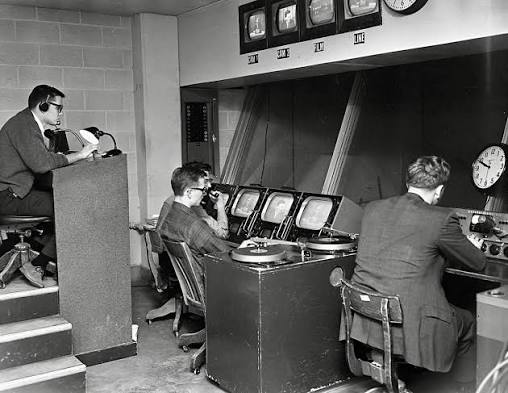
Archival photo of an early television broadcast control room. The refresh rate of these heavy CRT (cathode-ray tube) monitors had to be strictly synchronized with the local AC power grid frequency (60Hz in the US, 50Hz in Europe). It was this pure infrastructural limitation that split global television standards into the NTSC and PAL camps.(Image from internet)
The "Soap Opera Effect" and the Curse of High Frame Rates
Fast forward to the digital era. With the rise of 30fps, 60fps, and even 120fps displays, a new visual crisis emerged.
If higher frame rates mean smoother motion, why do audiences often hate it? This brings us to the dreaded “Soap Opera Effect.” When a movie shot at 24fps is artificially smoothed out by modern TVs using motion interpolation to hit 60fps, the natural motion blur vanishes. The footage suddenly looks hyper-realistic, overly sharp, and jarringly fluid—exactly like cheap, brightly lit daytime soap operas shot on basic camcorders.
The human brain associates the slight stutter and motion blur of 24fps with storytelling, fantasy, and the “cinematic dream state.” When you strip that away with high frame rates, you destroy the illusion, reminding the audience that they are just watching actors in makeup standing on a movie set.
[Chapter Summary & Reflections]
Technology dictates the baseline, but human perception defines the art.
The century-long evolution of frame rates is a fascinating paradox. 24 fps was born out of stinginess and the physical limits of audio tracks, yet it accidentally sculpted the psychological “dream state” of cinema for generations. The NTSC and PAL divide was merely a byproduct of the power grid, yet it defined regional visual cultures. Today, technology allows for infinitely smooth high frame rates, but it only proves one thing: in the realm of storytelling, absolute clarity is not always a virtue. Sometimes, a little bit of blur, a little bit of imperfection, is exactly what we need to believe in the magic.