

Humanity's Wild Fantasy of "Capturing Time"
If the camera is a flash of light carving an eternal fossil in the river of time, then the video camera (or cine-camera) is humanity’s frantic attempt to bottle that entire river and take it home.
Today, when we pull out a smartphone and casually record a 4K 60fps high-definition video, we rarely realize the breathtaking revolutions in physics, chemistry, and electronics that humanity went through over the past century to make pictures “move.” From the iron behemoths in Hollywood studios that required four or five people to move, to the magnetic tape cameras slung over war correspondents’ shoulders, and finally to today’s nimble digital mirrorless cameras, the evolution of the video camera is essentially a history of humanity’s struggle to expand the boundaries of vision.
The Dawn of Dream-Making — From the Zoetrope to the Lumière Brothers
The physical foundation of moving images is built upon a “flaw” in the human eye—persistence of vision. When a series of still images flashes before our eyes fast enough, our brain automatically bridges the gaps, creating the illusion of continuous motion.
Quick Trivia: What is “Persistence of Vision”?
Simply put, when you look at an object and it suddenly moves or disappears, its image doesn’t instantly vanish from your retina. Instead, it lingers for a brief moment—about 1/16 to 1/24 of a second.
In other words, our eyes and brain have a built-in “lag” when processing images.
How did this give birth to cinema? It is exactly because of this physiological “flaw” that humanity unlocked the secret to making time flow.
If we display a second, slightly altered still photo right before the 1/24-second afterimage of the first one fades, your brain will naturally “glue” these two static images together. If we continuously play a series of still photos at a speed of 24 frames (or even 60 frames) per second, the brain is completely “tricked.” It automatically fills in the gaps, turning these static slices into a continuous, fluid motion.
This is the physical origin of what we commonly refer to as Frame Rate (FPS, Frames Per Second).
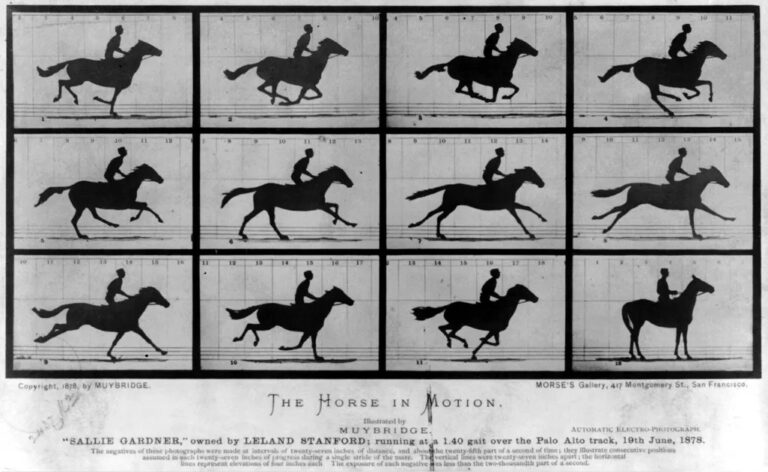
The true origin of the video camera stems from a wealthy man’s bet. In 1878, American railroad tycoon Leland Stanford (also the founder of Stanford University) made a wager: is there a moment during a horse’s gallop when all four hooves are off the ground simultaneously? To find out, he hired photographer Eadweard Muybridge. Muybridge set up 24 cameras along a track, triggered sequentially by tripwires. As the horse ran past and snapped the fine threads, the cameras triggered one after another.
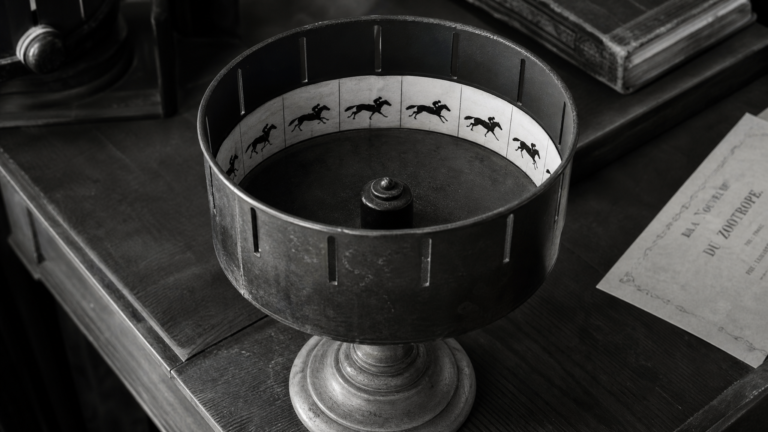
He not only won the bet (proving there is indeed a moment when all four hooves are airborne), but he also placed these 24 consecutive photos into a spinning disk device called a “Zoopraxiscope”. As the disk spun, for the first time in hundreds of years of human art history, the horse “ran.” This was the earliest seed of the motion picture camera.
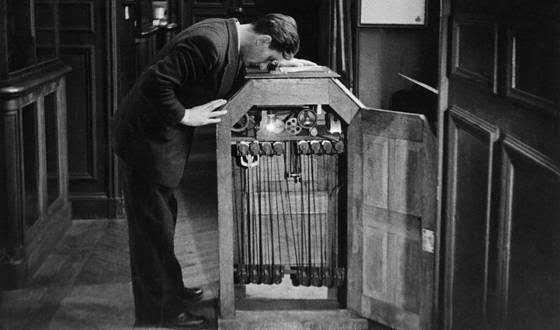
Thomas Edison, the great inventor, was quick to sharply capture this business opportunity. In 1891, Edison’s lab invented the “Kinetoscope”. However, Edison’s mindset was that of a thorough capitalist: he built a massive wooden cabinet with a single peephole on top. Viewers had to insert a coin and peer through the hole like a voyeur to watch the rapidly scrolling film inside. He believed that allowing only one person to watch at a time would generate more money.
However, it was the French Lumière brothers who truly endowed the video camera with its soul as a “mass medium” and “dream-maker.”
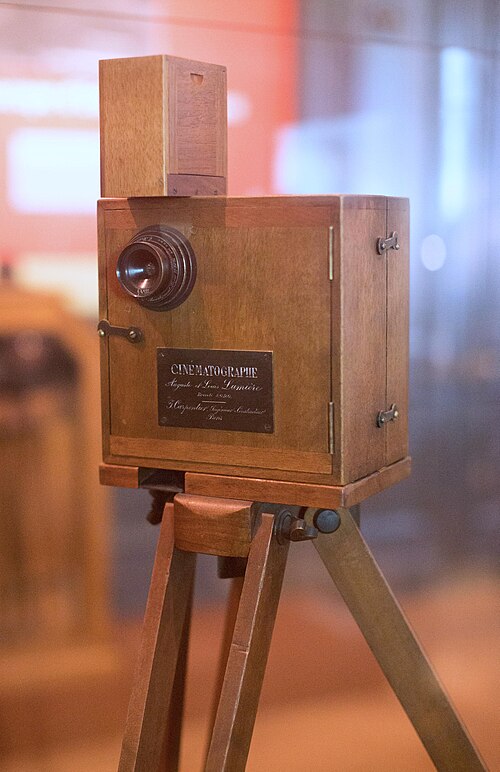
In 1895, the Lumière brothers invented the portable “Cinématographe”. This magical machine could not only shoot film but also project the images onto a large screen. On December 28 of that same year, in the basement of the Grand Café in Paris, they projected Arrival of a Train at La Ciotat to the public.
As the steam locomotive barreled toward the audience on screen, spewing white smoke, it triggered massive panic on site, with some even screaming and fleeing the projection room. People had never witnessed such a realistic, flowing recreation of space and time.
That was the first time the video camera showed its magic to the world. It declared the end of an era and initiated a century-long epoch of dream-making woven by light and shadow.
Industrial Behemoths of the Film Era
As the Lumière brothers pushed dynamic images to the public, this novel technology, originally known as an “amusement park trick,” quickly took root across the ocean in America. Eventually, in the sunny wastelands of Southern California, it spawned a massive dream-making empire named “Hollywood.”
If one word could describe the video cameras (or more accurately in that era, motion picture cameras) of Hollywood’s Golden Age, it would be—”Behemoths.”
The Iron Laws of the Empire: 35mm and 70mm Standards
In the early days of motion picture camera evolution, film sizes were highly varied, like a chaotic battlefield of warlords. The one who ultimately unified the industry was still that shrewd and dominant businessman, Edison, and his assistant William Dickson. They cut 70mm unperforated film in half and punched four sprocket holes per frame on both sides. This became the “35mm film” standard that ruled the visual industry for over a century.
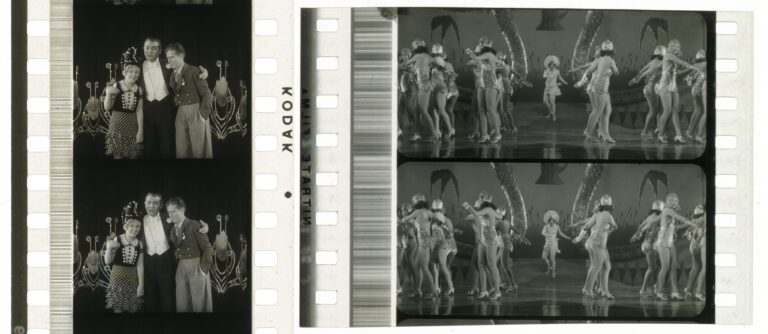
By the 1950s, with the popularization of television sets, movie theaters faced an unprecedented crisis. To pull audiences back into theaters, Hollywood unleashed its ultimate weapon—the 65mm camera, featuring a much larger format and terrifyingly sharp resolution (which becomes 70mm film when the soundtrack is added during projection). From Lawrence of Arabia to 2001: A Space Odyssey, these epic blockbusters all relied on this large-format film. Every upgrade in film size meant a complete restructuring of the camera’s internal gears, claw mechanisms, and optical components, which also meant the machine’s physical size grew increasingly massive.
Heavy, Expensive, and Massive Studio Monsters
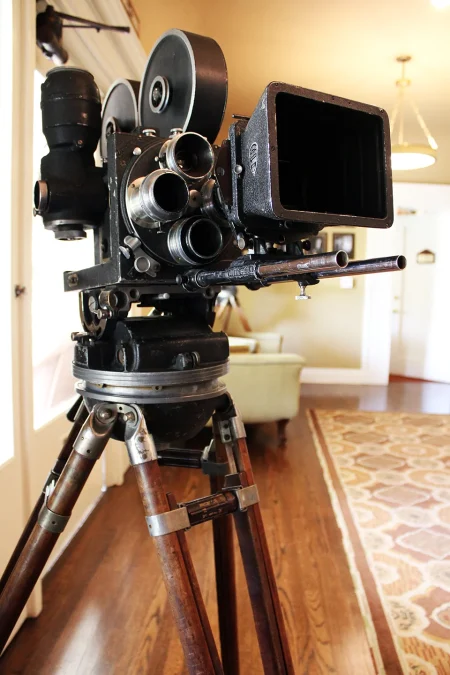
Today’s creators are long accustomed to carrying a mirrorless camera single-handedly, or even mounting it on an FPV drone to fly through the sky. But on Hollywood sets in the mid-20th century, a standard cinema camera was entirely a crystallization of heavy industry.
Take the legendary Mitchell BNC camera, which dominated Hollywood for decades, as an example: the machine itself was as heavy as a boulder. Even worse, with the advent of “sound films (talkies)” in the late 1920s, the loud noise generated by the gears of early cameras became a sound mixer’s nightmare. To achieve sync-sound recording, engineers had to encase the camera in a tremendously heavy metal cover known as a “Blimp.”
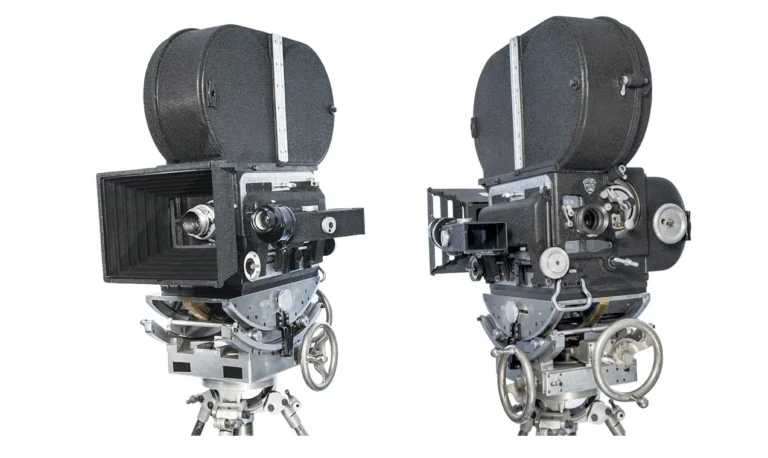
If you went back to the sets of that time and saw the three-strip camera used to shoot early “Technicolor” films, your jaw would drop at its size. To capture full color, the machine had to run three strips of black-and-white film simultaneously (recording red, green, and blue separately) through a beam-splitting prism. This incredibly complex mechanical structure inflated the camera to the size of a small armored vehicle.
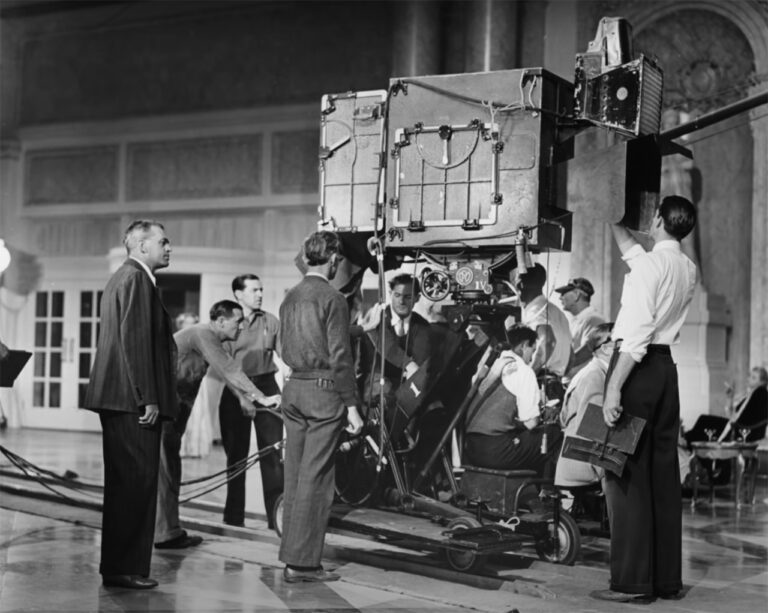
These industrial behemoths were definitely not something one person could operate. Their operation required a strict assembly line: the camera operator closely watched the viewfinder to frame the shot; the first assistant camera (focus puller)—in an era without external monitors—relied entirely on measuring tape and terrifying intuition to keep the focus sharp; the second assistant camera was responsible for struggling to load and unload film magazines weighing dozens of pounds.
Dollar-Devouring Machines and Strict Discipline
In that era, cameras were not only light-eating monsters but also black holes devouring dollars. Every time a director yelled “Roll Camera,” accompanied by the high-speed spinning of the motors inside, dozens of centimeters of extremely expensive Kodak film burned away. This high physical cost shaped the almost militaristic, strict discipline on Hollywood sets.
There was no room for “let’s just shoot it and fix it in editing later” back then. Directors, cinematographers, and actors had to rehearse blocking, lighting, and focus with the precision of a Swiss watch before the camera truly rolled. This rigor, forced by the massive equipment and expensive medium, paradoxically tempered the audiovisual language to a great extent, casting the golden age of cinema filled with masters.
However, these heavy, massive machines were destined to be locked onto heavy-duty tripods, dollies, and giant cranes. They belonged to enclosed soundstages and highly controlled lighting laboratories. But the outside world was undergoing drastic changes.
The era was calling for a lightweight recording tool that could be carried on the shoulder, one that could rush into real streets and war zones. The video camera was about to welcome its first “slimming revolution.”
The Tape Revolution and the Rise of ENG (Electronic News Gathering)
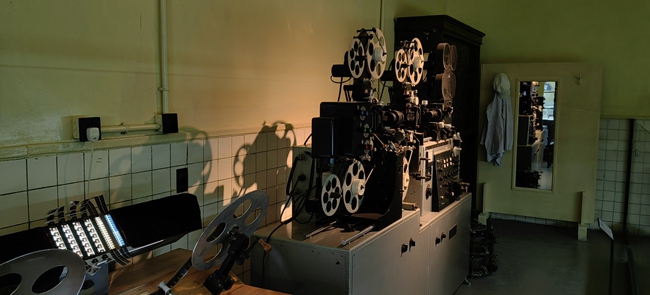
Although those heavy industrial monsters in Hollywood studios captured legendary film textures, they had a fatal weakness: the time delay.
Once a roll of motion picture film was shot, it had to be sent to a professional lab for complex chemical development. From shooting to the audience seeing the footage, it took days at best, and sometimes months. In the film industry, which pursues extreme art, this waiting was called the “romance of the blind box”; but in the ever-changing news industry, this delay was intolerable.
In the mid-20th century, the television broadcasting industry began to explode. TV stations needed to broadcast a massive amount of news and programming daily. They urgently needed a recording medium that didn’t require chemical processing, could be played back instantly, and could even be transmitted directly via radio waves.
The Birth of the Videotape Recorder (VTR): Farewell to the Processing Pool
This dilemma was completely resolved by “Magnetic Tape.”
In 1956, the American company Ampex demonstrated the world’s first practical videotape recorder—the VR-1000—at the National Association of Broadcasters convention. This machine used two-inch wide magnetic tape and, through incredibly complex rotating magnetic heads, converted video signals into magnetic signals for recording.
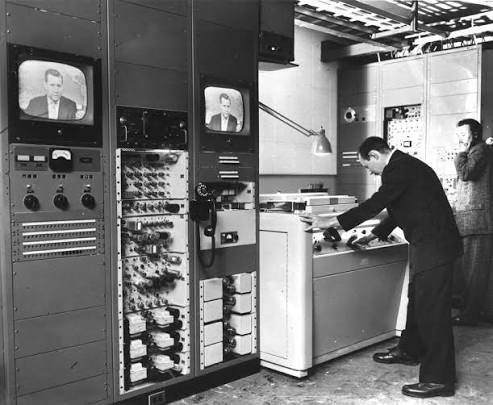
When the on-site camera captured the footage, and Ampex engineers immediately rewound the tape and hit play, the clear black-and-white images instantly appeared on the TV monitor. The whole crowd erupted.
Images finally no longer relied on chemical potions; instead, they became electronic signals that could be instantly rewritten and replayed.
But this VR-1000 was still as massive as several upright freezers side-by-side, costing up to $50,000, and could only be housed in a TV station’s machine room. News reporters covering stories outside still had to charge into the field carrying relatively lightweight 16mm film cameras (like the classic Arriflex 16ST) and then rush the film back to the station for urgent processing.
The ENG Revolution: Carrying the Broadcast Truck on Your Shoulders
It wasn’t until the 1970s, with the miniaturization of electronic components, that a revolution known as ENG (Electronic News Gathering) officially broke out.
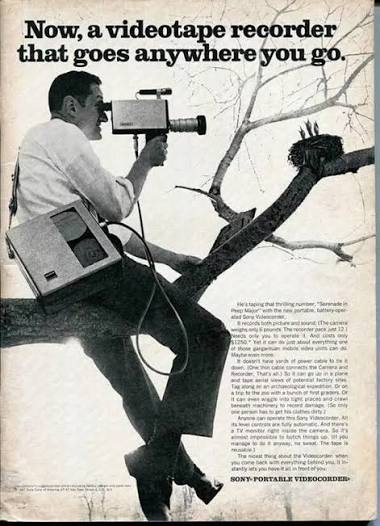
The Japanese took the lead in this miniaturization battle. Manufacturers like Sony and Panasonic forcefully compressed the massive recording equipment that previously only fit in machine rooms into sizes that could be carried by a single person. Initially, these ENG setups were separated: the cameraman carried a camera head containing a pickup tube on his shoulder, and a thick cable connected it to a portable video tape recorder (VTR) weighing over a dozen kilograms slung across his back.
Though still heavy, this was a qualitative leap. War correspondents and news gathering teams could finally break free from the shackles of film processing. The magnetic tapes capturing breaking news on the scene could be immediately transmitted back to the station via microwave trucks, achieving true “live broadcasting.”
The Birth of the Camcorder: Freedom for Documentarians
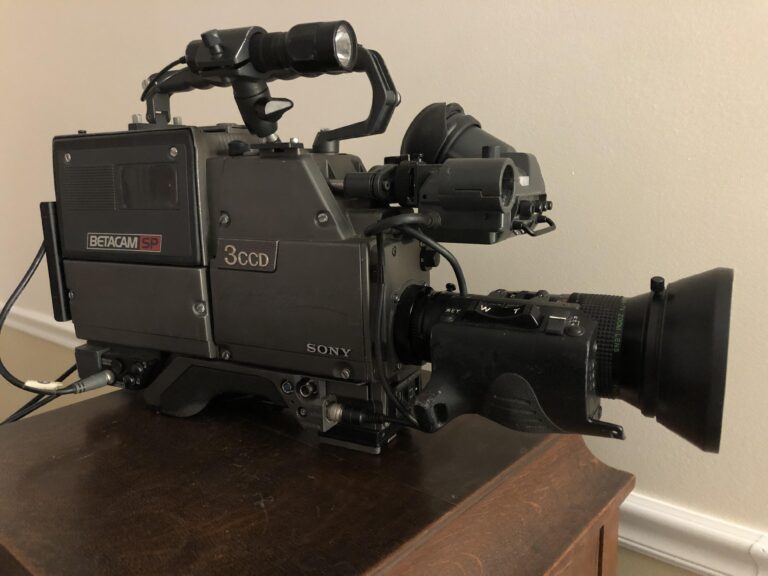
What truly brought ENG cameras to maturity was the Betacam format launched by Sony in the 1980s. Sony accomplished a feat that changed the industry ecosystem: they perfectly integrated the camera lens and the recorder into one single body, giving birth to the modern Camcorder.
From then on, this ruggedly shaped machine, with a center of gravity perfectly contoured to the human shoulder, became the ultimate weapon for countless news workers, documentary directors, and early independent filmmakers worldwide. It required no darkroom and no complex light metering. Just push in a tape, press the red REC button, and the images were locked onto the tape.
From frontline reports in the late stages of the Vietnam War, to the historical moments of the fall of the Berlin Wall, to sudden news on countless late-night streets—these gritty but powerful tape images shaped modern people’s perception of the world with astonishing timeliness.
The machines got smaller, the lenses gained freedom, and the video camera finally stepped out of the high-walled soundstages of Hollywood, truly arriving in the real world filled with mud and smoke. And in the next decade, this tide of electronification would break through the barriers of the professional field, surging into every ordinary person’s home with an even more wild and organic growth.
Entering Ordinary Homes — The DV Carnival and the Birth of the "Independent Creator"
As mentioned earlier, ENG shoulder-mounted cameras gave news reporters freedom, but their price tags of tens of thousands of dollars and extremely complex professional operations still erected a high wall of despair between the general public and dynamic imagery.
Before the 1980s, if an ordinary family wanted to record dynamic moments of life, they could only use extremely expensive 8mm film cameras that required chemical processing. Back then, recording a home video was a highly ritualistic and luxurious event.
That was until the Japanese decided to squeeze this expensive machine into the palm of an ordinary person’s hand.
The Dimensional Strike of the “Handycam”
In 1985, Sony officially launched its first-generation Handycam in Japan—the CCD-M8.
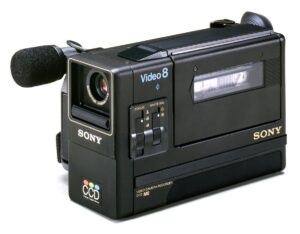
This was an era-defining name. “Handycam” literally meant “a camera that can be held with one hand.” To achieve this crazy reduction in size, engineers abandoned bulky vacuum camera tubes, fully adopted miniature solid-state image sensors (CCD), and shrank the videotape to its absolute limit (the Video8 format).
The size of this machine was merely equivalent to a slightly thick passport, weighing less than a kilogram. Ordinary people didn’t need any professional optical or audio training; they simply slipped their hand through the side strap, pressed the iconic red record button with their thumb, and the daily accounts of life were permanently sealed in magnetic tape.
From that moment on, the video camera completely shed its arrogant cloak of “heavy industry” and “professional media,” transforming into a household appliance. A child’s first steps, parents’ birthday parties, scenery during travels—all began to be recorded in countless family TV cabinet drawers as analog signals with slight snow noise and somewhat muted colors.
MiniDV and FireWire: The Dawn of the Digital NLE Era
By the mid-to-late 1990s, an even more profound underlying revolution quietly occurred—the DV (Digital Video) format was born.
The most dominant among them was the smaller, visually stunning MiniDV cassette. Although images were still recorded on magnetic tape, what was stored inside was no longer an easily degrading analog waveform, but pure 1s and 0s of digital signals.
Arriving alongside MiniDV was a cable that completely changed the history of video production—IEEE 1394 (which Apple called FireWire).
Before this, video editing was the monopoly of expensive and massive linear editing machines in TV station control rooms. But now, a thin FireWire could connect a DV camera directly to a personal computer at home. Video data was losslessly “captured” onto a hard drive, and ordinary people could finally drag, cut, and reorganize timelines freely with a mouse on their computer screens.
The Birth of a New Profession
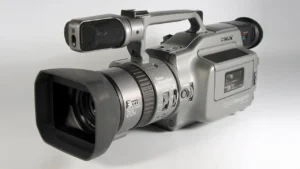
This complete “democratization” of shooting and post-production directly spawned a massive new demographic—independent video creators. As long as you had a machine like the Sony VX1000 (a legendary 3CCD prosumer DV camera) or the Panasonic DVX100, paired with a computer loaded with non-linear editing software, a single person became a production studio.
A massively large branch of video training today—Wedding Videography and event coverage—truly experienced an explosive boom during that DV era. In the past, weddings were mostly documented with static photography; but in the DV era, countless young people with video dreams started taking commissions with a lightweight DV camera and a desktop PC. They accomplished lighting, recording, and editing at an extremely low cost, forcefully cracking open a huge commercial market.
This was a carnival era belonging to the grassroots. Equipment was no longer an excuse hindering creativity. However, while home DV was wildly popularizing, a group of geeks in Silicon Valley and traditional bosses in Hollywood were secretly brewing a destructive “digital tsunami.” Traditional cinema film was about to meet the most terrifying terminator in its century-long history.
The Digital Tsunami and the Cinema Industry's "Clash of the Titans"
While the consumer DV market was fighting fiercely and TV news had been completely taken over by tape cameras, the Hollywood film soundstages, standing at the top of the imaging industry pyramid, were still dominated by film.
In the eyes of old-school filmmakers in the early 21st century, no matter how convenient the electronic signals of the TV industry were, they could never match the fascinating texture of 35mm film—tempered over a century—in terms of dynamic range, color depth, and that elusive “breathing” quality. The digital cinema cameras of the time (like the Sony HDW-F900, which George Lucas used to shoot Star Wars: Episode II), although touting the banner of “High Definition,” were seen by film purists as nothing more than cheap, plastic-looking electronic images.
That is, until an “outsider” from Silicon Valley kicked open Hollywood’s doors.
The Silicon Valley Geek’s Mad Diary: RED and the 4K Red Storm
In 2005, Jim Jannard, the billionaire founder of the Oakley sunglasses brand and a fanatical camera geek, announced the establishment of a company called RED Digital Cinema.
His goal was extremely arrogant: to build a digital cinema camera with a resolution up to 4K (four times the pixels of what was then called HD), capable of shooting RAW formats, and priced cheap enough for independent filmmakers to afford. In Hollywood at the time, no one took this sunglasses salesman seriously; everyone thought it was a Silicon Valley pipe dream of a tech fanatic. However, in 2007, the RED ONE truly burst onto the scene.
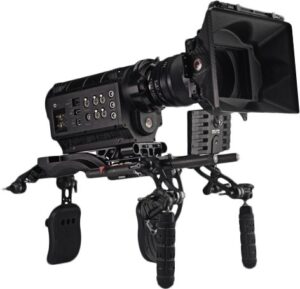
This was a monster that looked like a modular weapon from an armory. It had no tape compartment, directly writing massive data streams to specialized hard drives; what it shot was not a compressed video, but RAW format data files just like a digital DSLR. What was even more terrifying was that its resolution genuinely reached 4K.
Frontline Hollywood directors like Peter Jackson (director of The Lord of the Rings) and Steven Soderbergh were utterly shocked after testing the RED ONE. Those 4K RAW files, which could be color-graded directly on a computer screen, not only offered an astonishing dynamic range close to film but completely eliminated expensive film processing costs and long waiting times.
Silicon Valley’s Moore’s Law finally swung its ruthless scythe at Hollywood’s century-old film industry. The red storm stirred up by RED announced the full arrival of the digital cinema era.
The Empire Strikes Back: ARRI’s Digital Metamorphosis
Faced with the dimensional strike of the Silicon Valley upstart, the century-old German giant ARRI, which had ruled the cinema camera market for decades, did not just sit still. Unlike RED’s pursuit of extreme resolution and the fast-moving Silicon Valley geek spirit, ARRI, with its century of history, understood better what cinematographers actually needed. In 2010, ARRI launched their true digital trump card—the ALEXA.
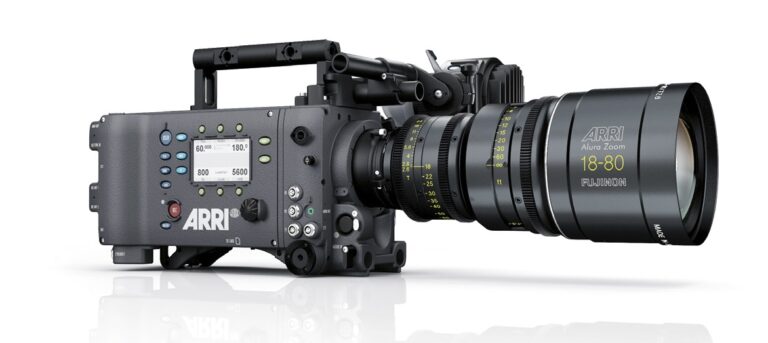
The ALEXA didn’t blindly chase 4K from the start; instead, it fiercely locked onto a core metric: dynamic range and the color science of filmic texture. ARRI’s engineers spent tremendous effort simulating the highlight roll-off and skin tone rendering of 35mm film.
Facts proved that ARRI made the right bet. For top Hollywood Directors of Photography, compared to cold, high-resolution pixels, they cared more about whether highlights would clip into dead white, and whether the skin tones on actresses’ faces appeared soft and natural. The footage shot by the ALEXA possessed the warm, moist texture closest to traditional film among digital cinema cameras at the time.
Coupled with ALEXA’s extremely stable operating system (crews dread camera crashes the most) and a user interface that matched the intuitive operations of traditional cinematographers, it reclaimed the Hollywood throne from film in a very short time and remains the first choice for the vast majority of Oscar-winning films to this day.
The Clash of the Titans and the Vanishing Film Labs
RED brought the revolution of resolution and digital workflows, while ARRI defended the dignity of film texture and color science. In the epic clash between these two giants, Japanese manufacturers like Sony and Panasonic also introduced their high-end digital cinema cameras (like Sony’s CineAlta series) to join the battle.
Amidst the rumbling artillery of this clash of titans, Kodak filed for bankruptcy reorganization, and the film processing labs around Hollywood closed down one after another. The rolls of celluloid film that accompanied the film industry for a century eventually became an expensive faith and performance art maintained by a few directors (such as Christopher Nolan and Quentin Tarantino).
In the mainstream market, the digital wave of photoelectric conversion had become irreversible. But what these high-and-mighty cinema camera giants never expected was that the device which truly democratized the digital “cinematic look” at dirt-cheap prices to ordinary creators worldwide was not them, but an SLR camera originally designed to take still photos.
Democratizing Hollywood and the Mirrorless Crossover
While Hollywood giants were still arguing over RED’s 4K resolution and ARRI’s film colors, a genuine grassroots imaging revolution was accidentally triggered in 2008 by a camera originally meant for static photography.
The Accidental Misfire of the 5D2 and the Grassroots Carnival of “Shallow Depth of Field”
In 2008, Canon released the full-frame digital SLR camera EOS 5D Mark II (commonly known as the “5D2”). To cater to the multimedia needs of photojournalists, Canon engineers “casually” added a feature to record 1080P Full HD video into this still camera.
Canon themselves didn’t realize what kind of monster they had unleashed.
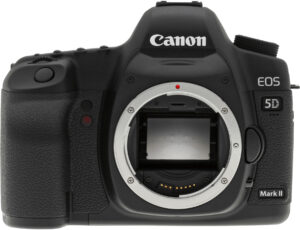
Before the 5D2 appeared, standard home DVs or professional news camcorders had very small sensor sizes (usually 1/3-inch or 2/3-inch). A small sensor means an extremely deep depth of field—the image is always in focus from the foreground to the background, looking like a cheap “TV broadcast.” The premium feel of traditional cinema film was largely due to the “shallow depth of field” effect brought by its massive 35mm negative (where the subject is sharp, and the background melts away like butter).
When independent directors and video studio creators discovered that by spending less than $3,000 on a 5D2 and pairing it with a cheap large-aperture prime lens, they could shoot “background blur” and a “cinematic look” comparable to a $100,000 Hollywood cinema camera, the entire industry went completely insane.
Countless wedding videography teams, independent short film directors, and commercial advertising studios collectively threw away their bulky tape camcorders and started shooting video with DSLRs. From the season finale of House M.D. to countless micro-films that exploded on the internet, the VDSLR (Video DSLR) era kicked off with a bang. Hollywood’s seemingly unreachable “cinematic look” was thoroughly democratized for the first time.
The Complete Takeover of Mirrorless: The Descent of the All-Round Era
However, DSLR cameras were ultimately designed for flat photography. Shooting video with a DSLR had insurmountable physical flaws: the reflex mirror had to be locked up during recording, causing the optical viewfinder to go completely black, forcing users to manually focus painfully using a low-resolution screen; the body’s heat dissipation was terrible, often overheating and crashing mid-shoot; and the audio recording features were appallingly basic.
To solve these pain points, imaging equipment ushered in another massive evolution in its history—Mirrorless cameras.
Panasonic’s Lumix GH series was the first to chop off the obstructive mirror box, pushing video recording stability to the extreme. Soon after, Sony charged into the battlefield with its A7S series in a highly aggressive posture: full-frame sensors, terrifying low-light high ISO capabilities (ISO could be cranked to hundreds of thousands, acting like night vision goggles in the dark), and an increasingly insane autofocus system.
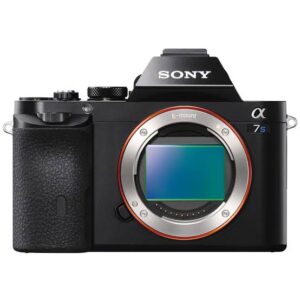
With the complete maturation of mirrorless technology, today’s small and medium-sized video teams and independent creators have entered an incredibly fortunate era.
Current full-frame mirrorless cameras are not only compact enough to be hung single-handedly on a gimbal, but they also feature incredibly robust built-in 5-axis image stabilization. They can even internally record 10-bit 4:2:2 ultra-high-spec color data, leaving a bottomless space for post-production grading in DaVinci Resolve. Focus tracking, which once required the coordination of several people, now only requires tapping an actor’s eye on the screen, and the AI will lock onto the focus tenaciously.
The video camera has finally completed its metamorphosis from a “giant industrial machine” to a “precision smart electronic terminal.”
Epilogue: The Machine That Looks at Time, Ultimately Looks at Us
Sorting through this century-plus of imaging evolution, it’s as if we are watching a surging river of technology.
From the tripwires at Leland Stanford’s racetrack to the heavy 35mm film monsters; from the ENG tape cameras on the shoulders of war correspondents, to the high-computing-power full-frame mirrorless cameras everyone in our studio owns today, and even the smartphones in our pockets that can shoot blockbuster-quality video relying on “computational photography.”
The rapid surge of technology has trampled down countless technical barriers that once seemed insurmountable. Today, we no longer need to memorize complex developer formulas, nor do we need to pull focus with a measuring tape on set. Just press that red REC button, and time will obediently flow into a memory card, turning into sharp and crisp 4K or even 8K pixels.
But this inevitably makes veteran video creators like us fall deep in thought: When obtaining a “perfect and clear video” becomes so cheap and easy, what remains of the true value of imaging?
When I lead students and run courses at ME Studio, I often see young people suffering from severe “gear anxiety.” They argue endlessly over a sharper lens or a new camera body with one extra stop of dynamic range, yet they often ignore the story unfolding in front of the lens.
The video camera is a machine used by humanity to fight the passage of time. But what makes these passing moments meaningful is never the machine, but the person behind it.
Those images that truly touch the heart—like a father’s tear-rimmed eyes at a wedding, the smile of a street vendor in a documentary, or the highly emotional lighting choreography in a commercial… they do not depend on how big the sensor is. They depend on whether the creator possesses that sharp empathy; they depend on how you gaze at the world through the viewfinder.
Equipment dictates the floor of our images, but our life experiences and our understanding of aesthetics dictate the ceiling of our work.
In the next decade, perhaps AI video generation technology will completely overturn the current logic of shooting, or maybe brain-computer interfaces will allow us to record dreams directly. But no matter how machines evolve, as long as humanity still needs to be moved and needs to be remembered, those warm eyes hiding behind the viewfinder will never be replaced.